Windermere two-year report demands action to address ‘Poor’ water quality results
19 August, 2025
Results from the most spatially detailed water quality dataset for Windermere have been published today by scientists from the Freshwater Biological Association (FBA) and Lancaster University, in response to community concerns and gaps in traditional water quality monitoring.
The Big Windermere Survey (BWS) report, covering the period June 2022 to November 2024, demands action to address ‘Poor’ water quality results.
Windermere is a much loved, iconic body of water within the Lake District National Park and is visited and used by millions of people every year. There has been growing concern and questions raised about the water quality.
About the Big Windermere Survey
The Big Windermere Survey (BWS) saw 350 citizen scientists collect over 1,000 samples of water from Windermere and its wider catchment, during 10 sampling events spread across 2.5 years. Many of the 110 locations sampled had never previously been assessed for water quality.
The BWS is an innovative and impactful citizen science project first developed in 2022 through collaboration between the FBA and Lancaster University to assess the environmental health of Windermere, in response to community concerns and gaps in traditional water quality monitoring.
The water samples were analysed for 15 key water quality parameters. The focus of the report published today is on the concentrations of phosphorus and the bacteria Escherichia coli (E. coli) and Intestinal Enterococci (IE), critical indicators of ecosystem health and of the quality of water for lake users.

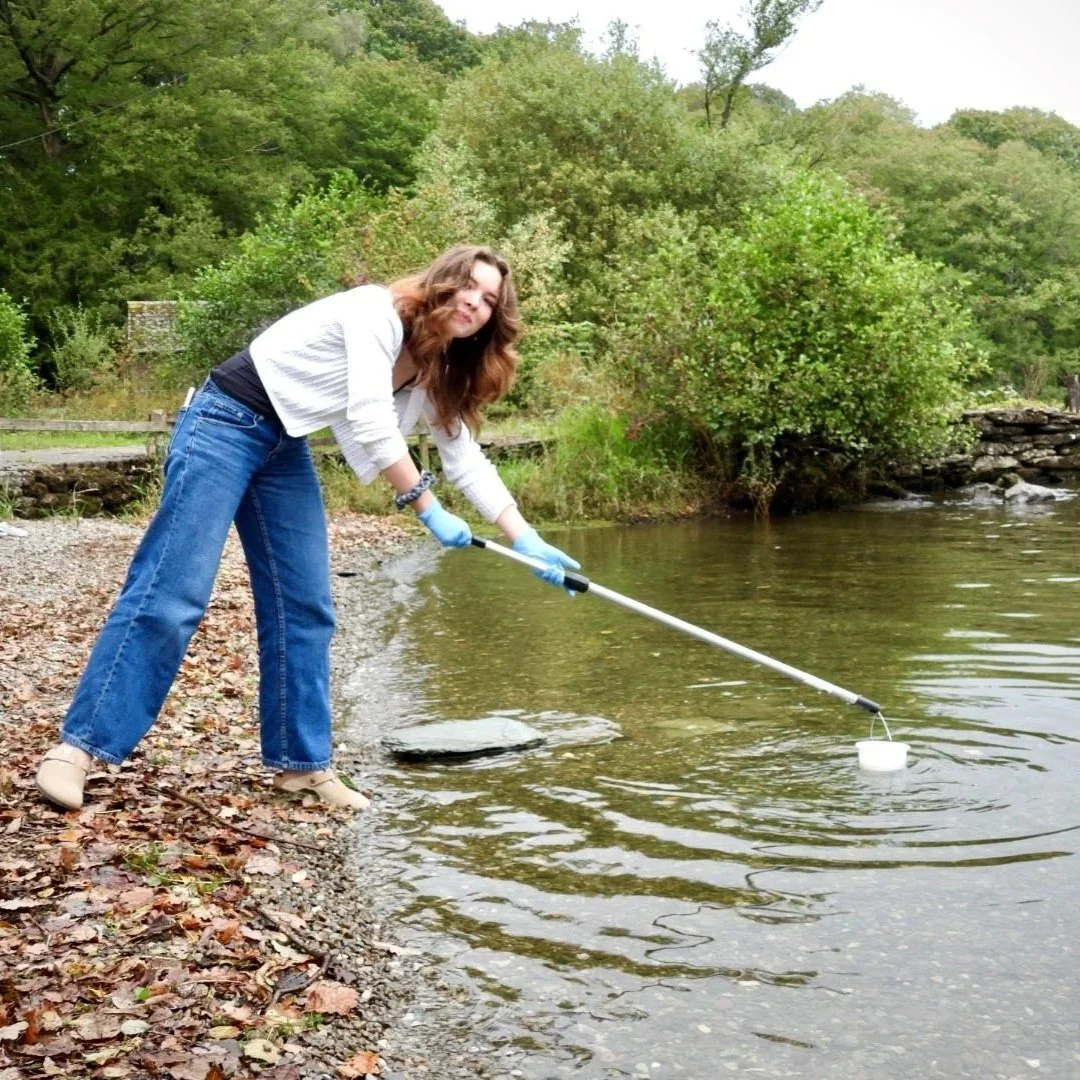
Photos of Windermere in the Lake District, Cumbria and Elizabeth Ellwood, BWS Citizen Scientist, taking a water sample.
Findings from the BWS report
Within their analyses, scientists grouped sampling locations around Windermere’s lakeshore into four areas - Northwest, Northeast, Southwest and Southeast. Water quality within each of these areas was then examined both seasonally and across the entire 2.5-year project.
Bacteria – Spatial Patterns
The BWS report reveals that concentrations of E. coli and IE bacteria were highest in the summer months, at times when Windermere is especially popular for activities such as bathing and watersports. Based on the report data, concentrations of bacteria in the Northwest, Northeast and Southwest areas of the lake in summer were only consistent with standards for ‘Poor’ bathing water quality.
The elevated bacterial concentrations in summer are particularly concerning as they indicate an increased risk of gastro-intestinal illness if water is ingested.
In spring, autumn and winter seasons, lower concentrations of E. coli and IE were consistent with standards for ‘Excellent’ or ‘Good’ bathing water quality across all areas of Windermere.
E. coli and IE are two groups of bacteria found in human and animal faeces. These bacteria can enter water from many different sources, including releases of treated wastewater from water company and private infrastructure, untreated sewage, runoff from agricultural land that hosts livestock, or via inputs from wildlife and birds that live in and around water.
Phosphorus – Spatial Patterns
All areas of Windermere were found to meet standards for ‘Moderate’ phosphorus status under UK legislation. This indicates that concentrations of phosphorus within the lake were higher than those required to meet the default target of ‘Good’ phosphorus status under this legislation.
Phosphorus primarily enters lakes through discharges of wastewater and runoff from agricultural or forestry land that has received inputs of phosphorus, such as from fertilisers. Elevated concentrations of phosphorus are of concern because they can trigger the process of eutrophication, resulting in negative changes within lakes. These changes include increased risks of cyanobacterial (blue-green algal) blooms, and decreases in dissolved oxygen concentrations in water that can threaten fish and other organisms living in lakes.
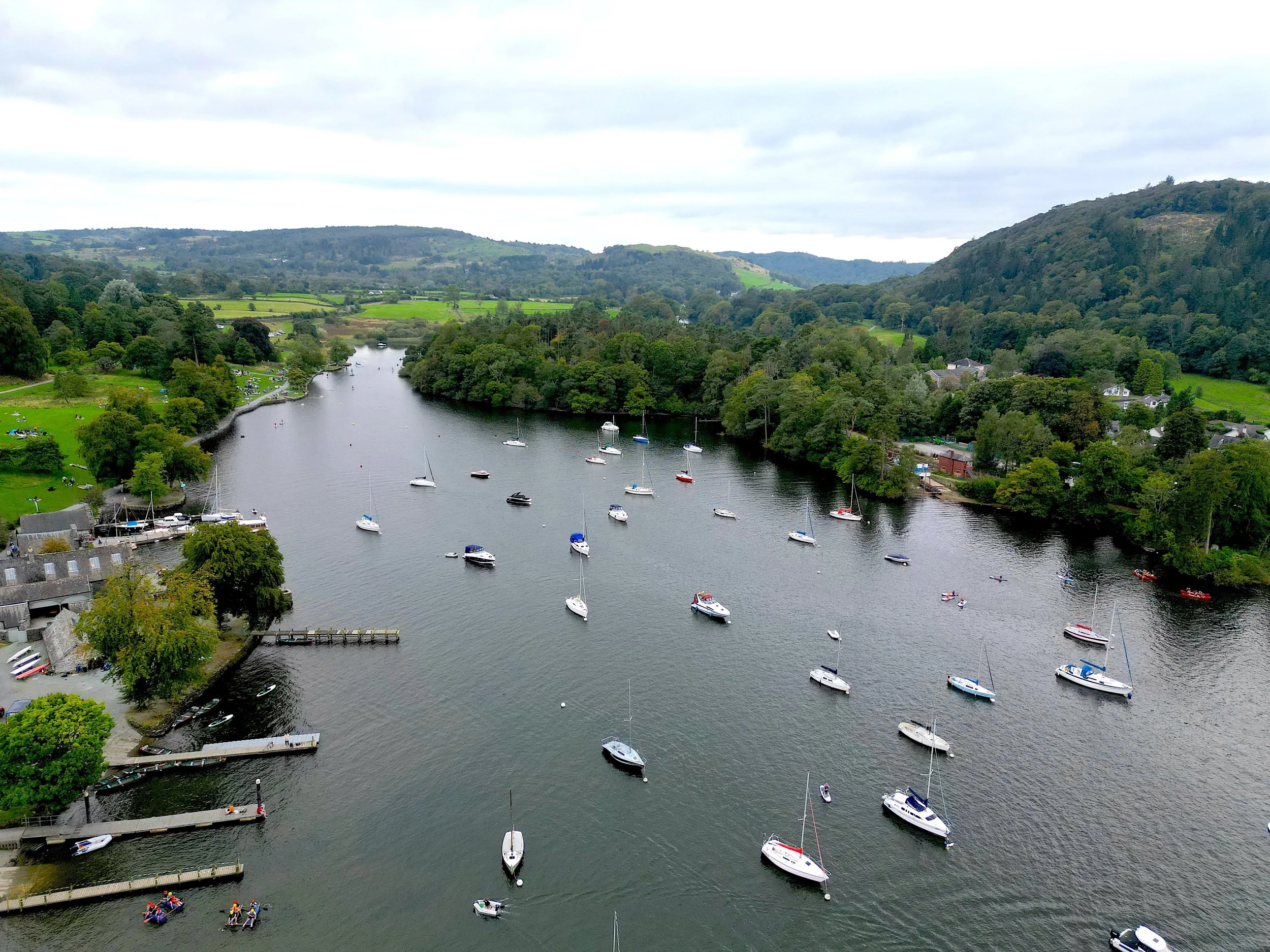
Aerial photograph of Windermere taken at Fell Foot.
“This report is the product of the incredible work our citizen scientists have carried out in collaboration with researchers at the Freshwater Biological Association and Lancaster University. Here we report upon the complex patterns in phosphorus and bacterial concentrations both spatially and seasonally within Windermere and shine a light on hotspot areas which show consistently elevated concentrations of these parameters. Restoration efforts should focus on these locations to drive the biggest and fastest reductions in phosphorus and bacterial concentrations.
We urge the relevant authorities to invest in ongoing monitoring through the BWS to evidence the benefits of targeted action to drive down nutrient and bacterial inputs. We also urge the Government to invest in regulation and enforcement to ensure all wastewater infrastructure, both private and water company, is fit for purpose.”
Poorer water quality hotspots on Windermere and in the Leven catchment
Beyond Windermere itself, the BWS also offers detailed insights into the water quality of rivers and other lakes across the wider Leven catchment.
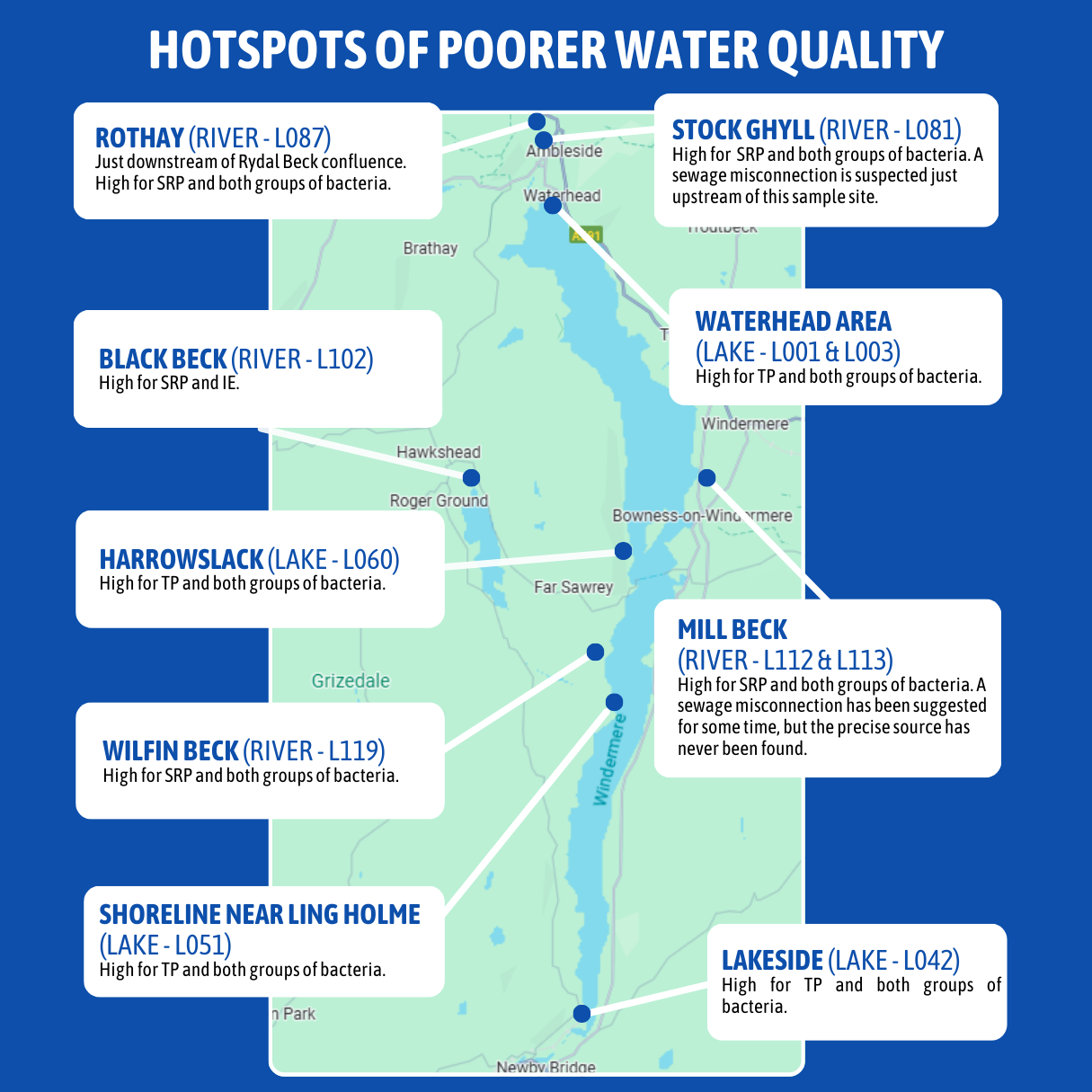
Hotspots for the concentrations of phosphorus or bacteria are revealed around Windermere’s shoreline at Waterhead, Millerground, Bowness Bay, Belle Isle, Mitchell Wyke Bay, southwestern shore sites, and near the River Leven outflow. Streams and rivers including Stock Ghyll, Black Beck, Mill Beck, Wilfin Beck and locations along the River Rothay also showed elevated concentrations of phosphorus or bacteria.
Map of hotspots of poorer water quality
Across all 10 BWS surveys, several sample sites have consistently demonstrated high concentrations of both phosphorus and at least one bacterial parameter. These sites were identified by calculating the median concentrations for phosphorus, intestinal enterococci (IE), and E. coli for all BWS sampling sites, ranking them from highest to lowest and then identifying as hotspots those sites where high phosphorus levels coincided with elevated concentrations of at least one bacterial parameter. Sites with low sample sizes, such as those only sampled once, were excluded. The top five river and lake sites with the poorest water quality are highlighted in the map below.
For more detail you can view the interactive maps of the BWS spatial dataset.
“The Big Windermere Survey is a unique collaboration between professional scientists and members of various communities with an interest in the water quality of Windermere and its catchment.
This collaboration has generated an unprecedented dataset which offers new insights into the spatial and temporal patterns of water quality in Windermere, built on exactly the same robust, scientific approaches used in water quality research.
We look forward to working with partners within the catchment to ensure that evidence generated by the Big Windermere Survey informs action that leads to real improvement in the water quality of this iconic lake.”
What actions are needed now?
The team behind the Big Windermere Survey is calling for data from the project to underpin actions that address the multiple pressures on water quality in Windermere’s catchment. These pressures include wastewater, both from water company assets and from privately managed systems, as well as land use activities within both rural and urban areas of the catchment. All land owners, farmers and asset owners have a collective responsibility to work together to improve Windermere’s water quality.
We will continue to work to ensure that the following actions are taken as a result of the findings published today:
1. ADDRESS HOTSPOTS & SOURCES OF POLLUTION
We call on all organisations and individuals within the catchment holding the remit to improve water quality to engage actively with the results we report here, and to implement actions that will protect and restore Windermere’s water quality. For example, we have clearly identified pollution hotspots in the catchment that should be resolved as a matter of urgency.
2. INVESTMENT IN WASTEWATER INFRASTRUCTURE & REGULATION
Urgent investment is needed both to ensure that all wastewater infrastructure (private and water company) is fit for purpose and adequately monitored, but also that the regulatory capacity exists to ensure pollution risks of all kinds are tackled with urgency and rigour.
We believe that Windermere could become an exemplar, demonstrating how collaborative, holistic action can effectively address water quality pressures within a catchment that is both iconic and under substantial pressure from human activity and climate change.
3. BUILD A ROBUST EVIDENCE BASE OF WATER QUALITY DATA
We continue to explore future funding commitments to enable the Big Windermere Survey to continue as a proven model that engages local people in citizen science and provides the necessary evidence to inform actions that improve water quality.
4. INCREASE BATHING WATERS MONITORING & REPORTING
We urge the Environment Agency to examine our bacterial data and to carefully consider issues such as the number of locations sampled for water quality analysis at designated bathing waters on Windermere, and the times of year monitoring is undertaken. There is also an urgent need for more regular and easily accessible communications to the community around water quality in their area.
Actions & next steps infographic
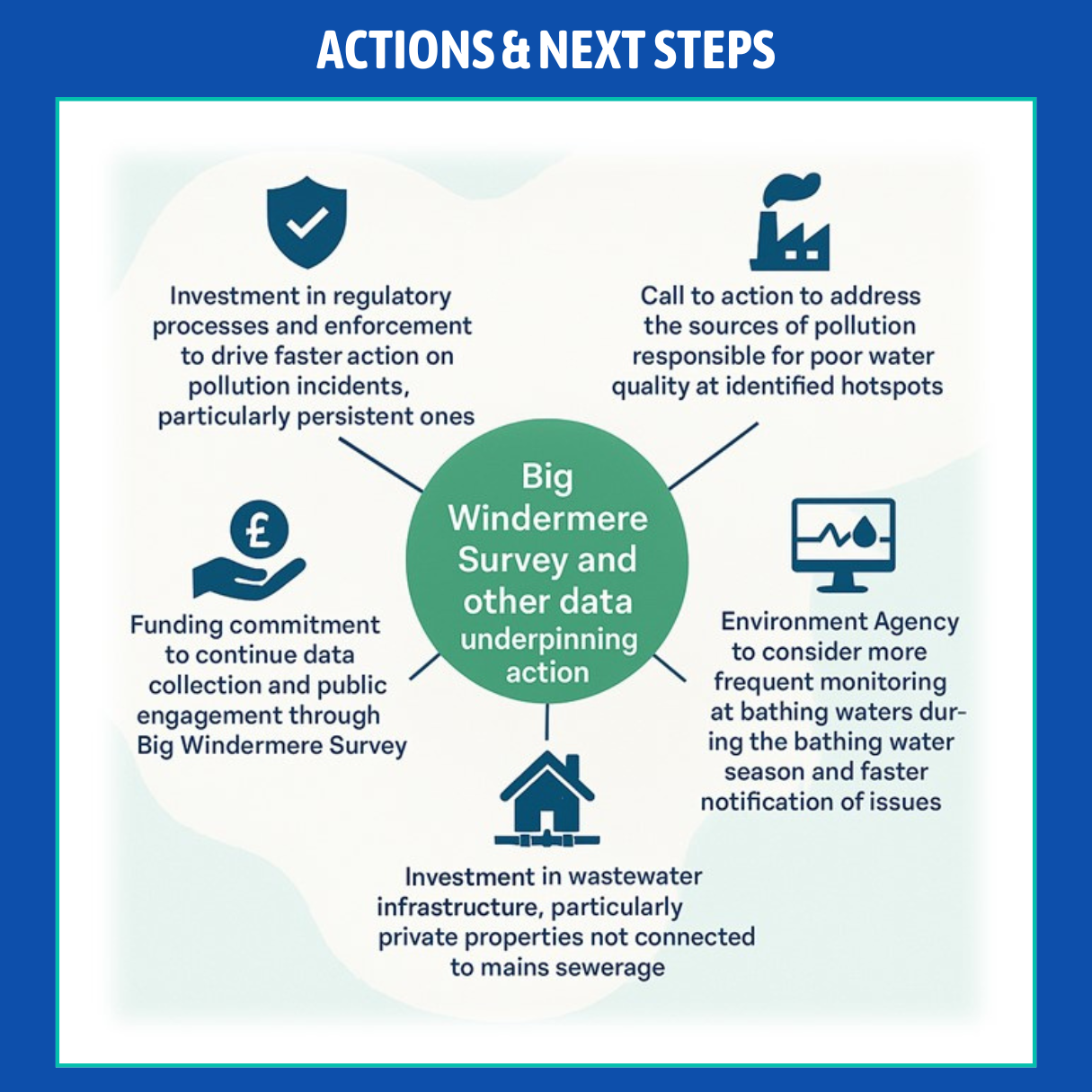
Infographic highlighting key next steps on tackling nutrient enrichment and high bacterial loading in Windermere, and how the Big Windermere Survey can underpin these activities and help target action.
“We are incredibly grateful to the hundreds of volunteers who have given thousands of hours of their time to gather the scientific data in this report. The evidence is clear and must lead to decisive action to improve water quality. We must all work together to transform the future of Windermere and deliver a cleaner, healthier and safer waterbody for all life to thrive.
Windermere is home to a number of rare and increasingly threatened freshwater species including Arctic charr. Without decisive action to improve water quality, this species and potentially many more will face a steady and devastating decline.
We hope these findings will not only advance scientific understanding of Windermere’s water quality but also play a pivotal role in shaping future strategies to protect and enhance the health of the lake and its surrounding catchment.”
Big Windermere Survey Report
The data from the Big Windermere Survey are being actively shared with a range of organisations both locally and nationally, as part of on-going conversations about the water quality of Windermere. The report released today, alongside all the underpinning data, are freely and openly available for anyone with an interest in Windermere to examine.
Interested in finding out more about the BWS?
We would like to thank all of the incredible citizen scientists who have given their time to participate in the Big Windermere Survey so far, and all our amazing supporters. We look forward to continuing to work with you in the future!
Project Partners
The Big Windermere Survey is a partnership project between the Freshwater Biological Association and Lancaster University.
We are grateful for the kind financial contributions to the project from Aviva Community Fund, Environment Agency, Lake District Foundation, Lake District National Park Authority, Lakeland, Lancaster University, National Trust, United Utilities, Westmorland and Furness Council and private donations.