26 November, 2026
A new report ‘England’s Ice Age Survivor: Conserving Arctic charr in the Lake District’ is published today – by the Freshwater Biological Association – as part of the Lake District Charr Recovery and Management (LD-CHARM) partnership.
The report provides further scientific evidence that Arctic charr are still present in Windermere, but are in serious decline with the species facing extinction in Windermere unless urgent action is taken to improve water quality and breeding habitat.
The Arctic charr is one of England's oldest native freshwater fish species, having inhabited the Lake District since the end of the last Ice Age over 11,000 years ago. The species is an iconic part of the region's natural heritage and an important indicator of healthy freshwater ecosystems. Once present in eleven Lake District lakes, they are now restricted to just eight surviving populations, with three already lost.
Key LD-CHARM research findings
● No Arctic charr detected at historic spring spawning sites in Windermere or in the South Basin of Windermere.
● Fewer detections of Arctic charr and poorer eDNA signals in Windermere in 2025 compared to 2017.
● Spawning habitat quality has declined markedly since 2017 with silt and algae increasing.
● Introduced fish species are on the rise with ruffe, roach and bream more abundant and widespread than in 2017.
● Most Lake District lakes contain their own, very genetically distinct, population of Arctic charr. Within Windermere, autumn and spring spawners are also genetically separate lineages. The charr in Thirlmere likely originated from 20th century transplants of Windermere spring spawners.
Find out more about the LD-CHARM Research Findings 2026 and download the summary report on the link below, ‘England’s Ice Age Survivor: Conserving Arctic charr in the Lake District’.
LD-CHARM Research Findings 2026
Find out more about the LD-CHARM Research Findings 2026 and download the summary report, ‘England’s Ice Age Survivor: Conserving Arctic charr in the Lake District’, on the link below.
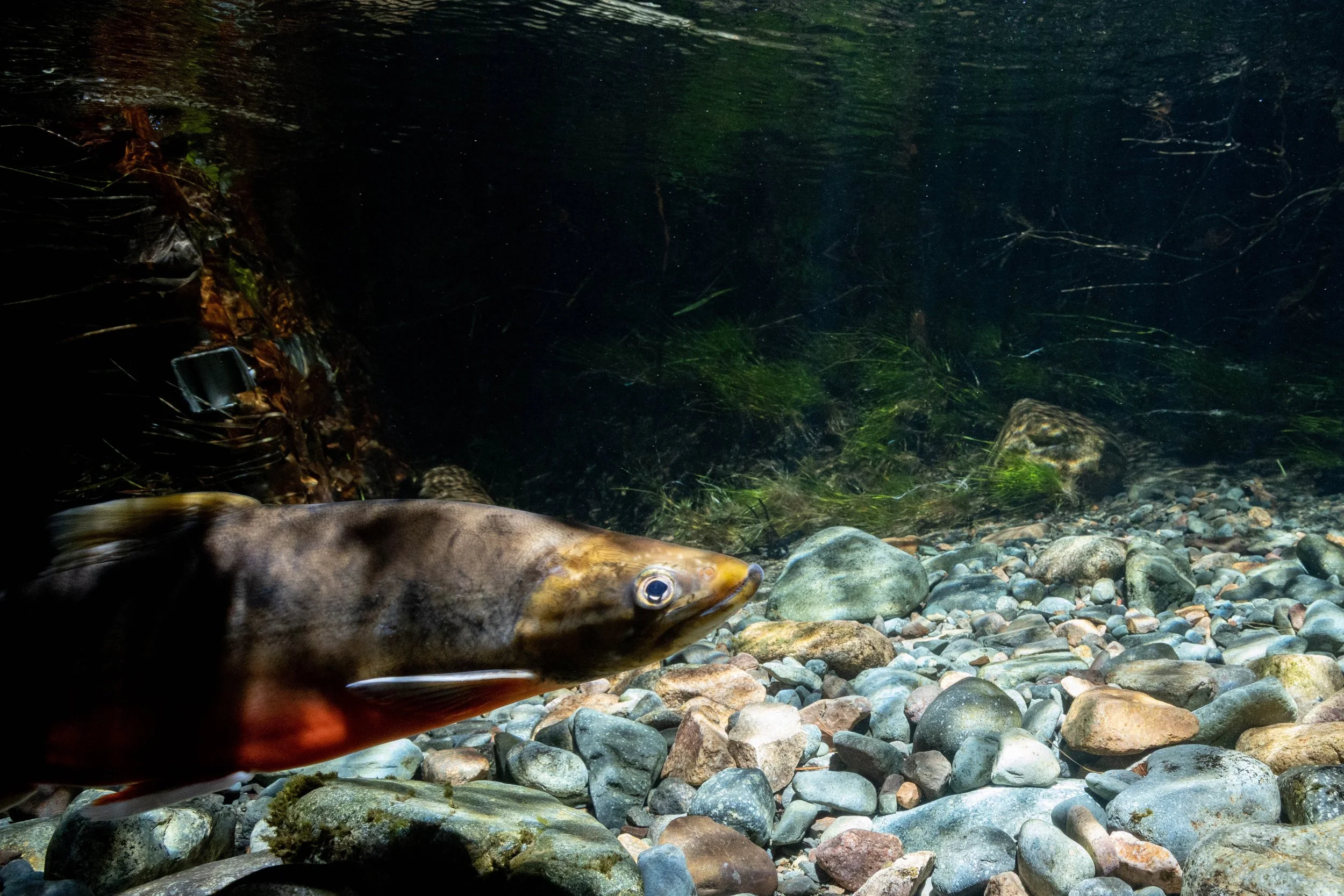
Photograph by Lindsay McCrae of England’s Ice Age survivor: the iconic Arctic charr.
Research methodology
The research was funded by Natural England's Species Recovery Programme. It combined underwater photography, hydroacoustics (using sound waves to measure the hardness of spawning ground substrate), and examination of fish DNA in the water (environmental DNA, or eDNA) to allow scientists to assess the quality of Arctic charr spawning grounds and see whether charr were attempting to breed there.
In Windermere there are separate autumn (November – December) and spring (January – March) spawning populations, with no recorded interbreeding between the two, but there is concern that the spring populations and those in the South Basin of the lake have declined in recent years. To investigate this, known and potential spawning grounds in Windermere were surveyed to test for presence of Arctic charr at breeding grounds and nearby waterbodies with historical or anecdotal evidence of charr.
By comparing these results with previous surveys in 2017, the study asked how conditions and populations have changed over time. Researchers also used the FBA’s 80-year old archive to genetically analyse Arctic charr scales to explore whether Windermere autumn and spring spawners are distinct populations and how charr differ among Lake District lakes.
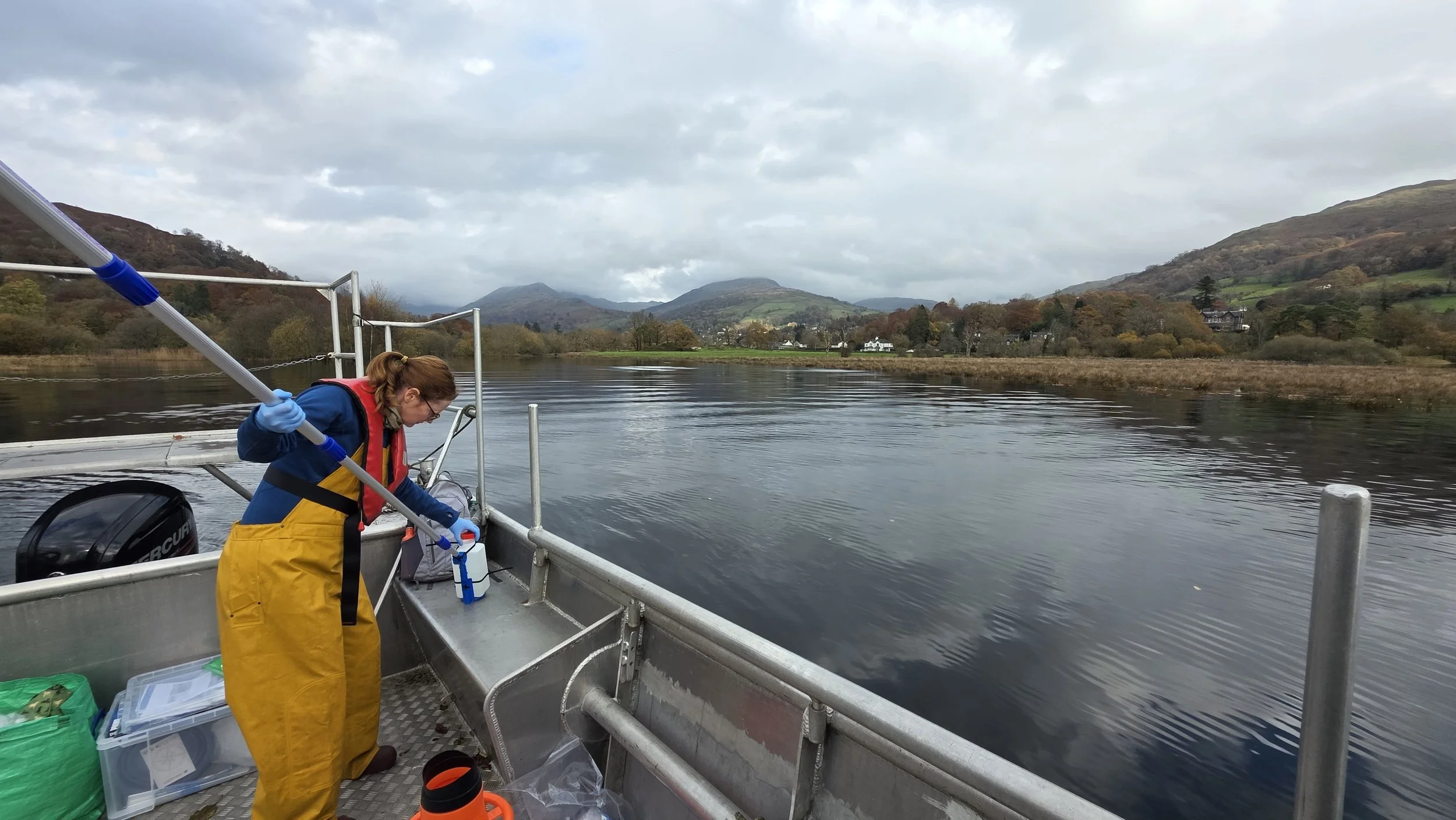
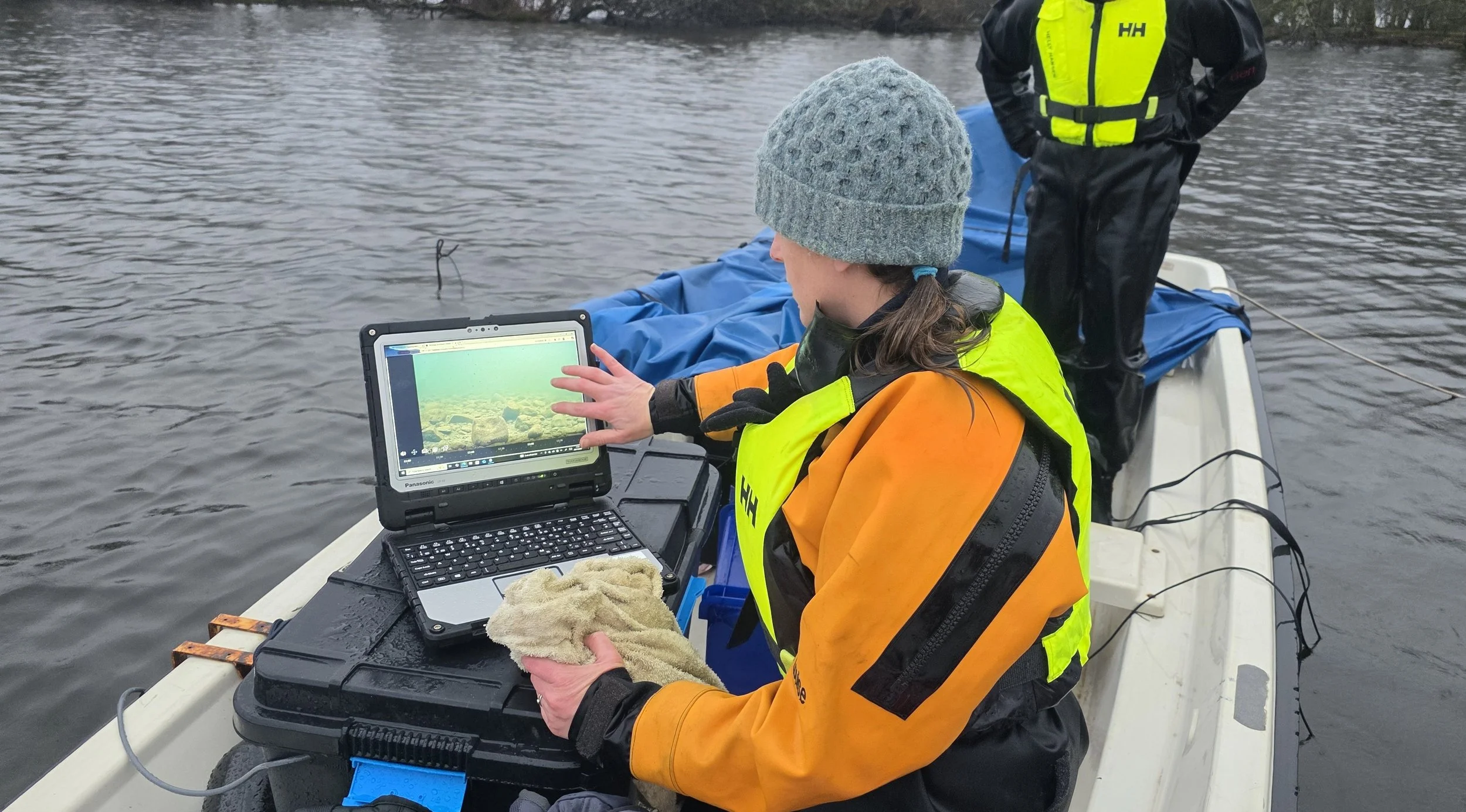
LD-CHARM research in action: Dr. Lori Lawson Handley, from UKCEH carrying out Arctic charr eDNA sampling on Windermere (left), and Dr. Louise Lavictoire, from the FBA (right).
What is the cause of the decline in Arctic charr populations in Windermere?
The research highlights a number of concerning changes since previous surveys in 2017. No Arctic charr were detected at historic spring spawning sites or in Windermere's South Basin, while fewer detections and weaker eDNA signals were recorded across the lake in 2025.
The quality of spawning habitats has also declined markedly, with increasing levels of silt and algae affecting the clean, hard substrates that Arctic charr need to reproduce successfully. Meanwhile, introduced fish species, including ruffe, roach and bream, have become more abundant and widespread. Arctic charr are a cold water fish, so increased water temperatures caused by climate change are an additional threat.
The three key pressures facing the Arctic charr in Windermere
1. Nutrient enrichment, caused by a combination of sewage from waste water treatment works and poorly managed private systems, and land uses such as agriculture and forestry.
2. Invasive species such as ruffe and roach, which compete for food and predate charr eggs and juvenile fish.
3. Rising water temperatures caused by climate change. Arctic charr, as a cold water fish, are sensitive to temperature change, particularly during their early life stages.
“Our action-focussed research has shown very clearly that we are at risk of losing Arctic charr from Windermere completely. The species is facing multiple pressures and our LD-CHARM research gives us the evidence, data and sense of urgency to take collective action to protect this ancient fish species before it’s too late.”
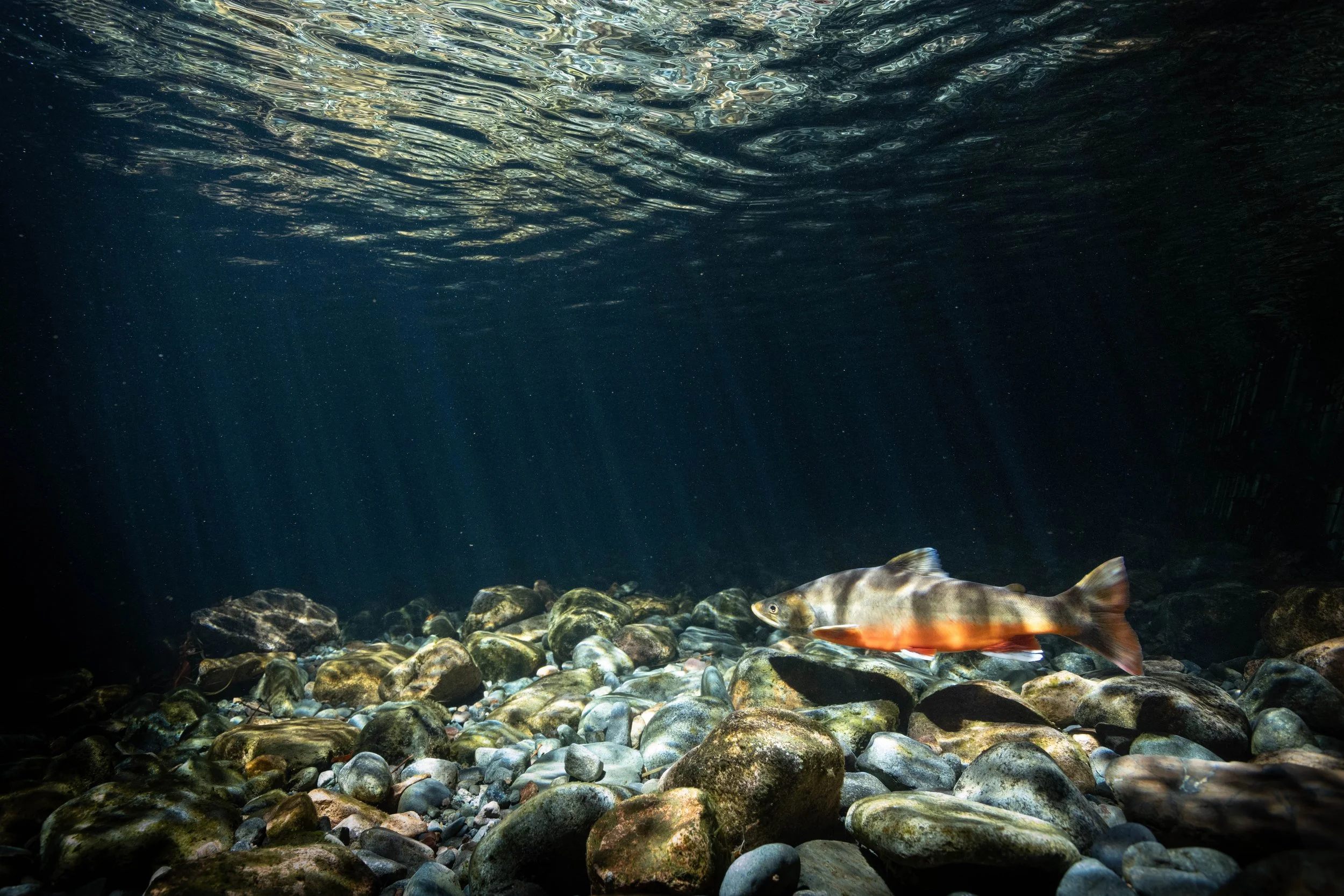
Underwater photograph of a Lake District Arctic charr by Lindsay McCrae.
What next to support Arctic charr populations in Windermere?
The LD-CHARM report identifies a number of priorities to support Arctic charr recovery in Windermere. These include reducing pollution from sewage and land run-off, restoring clean and suitable spawning substrates, and preventing further introductions of fish through improved awareness and biosecurity.
Further investigation is also needed to establish whether Windermere's spring-spawning population survives and whether Arctic charr are still breeding in the South Basin.
Actions required to support Arctic charr populations
● Reducing pollutants including sewage and run-off from the land in Windermere must be a priority.
● Restoring clean, hard spawning substrates is a high priority for Arctic charr recovery in Windermere.
● Preventing further introductions of species which directly impact Arctic charr through increased awareness and improved biosecurity.
● Confirming whether the Windermere spring spawning population still exists and whether any Arctic charr still breed in the south basin
The LD-CHARM project has created a coordinated approach for Arctic charr conservation in England and has secured three years of additional funding through Natural England's Species Recovery Programme to assess the other populations in the Lake District. This will help us to better understand the pressures facing England’s Arctic charr and the necessary conservation priorities.
“The Arctic charr is an iconic species, native to Cumbria, and a living link to the end of the last Ice Age. We know that good science and effective partnerships can bring our most threatened species back from the brink and this includes Arctic charr. LD-CHARM’s vital research will help us protect and restore charr in Windermere and lakes across the Lake District. We’re delighted to have supported the project through our Species Recovery Programme in 2025-2026, and we’re continuing our funding until March 2029 to reverse the decline of this remarkable fish.”
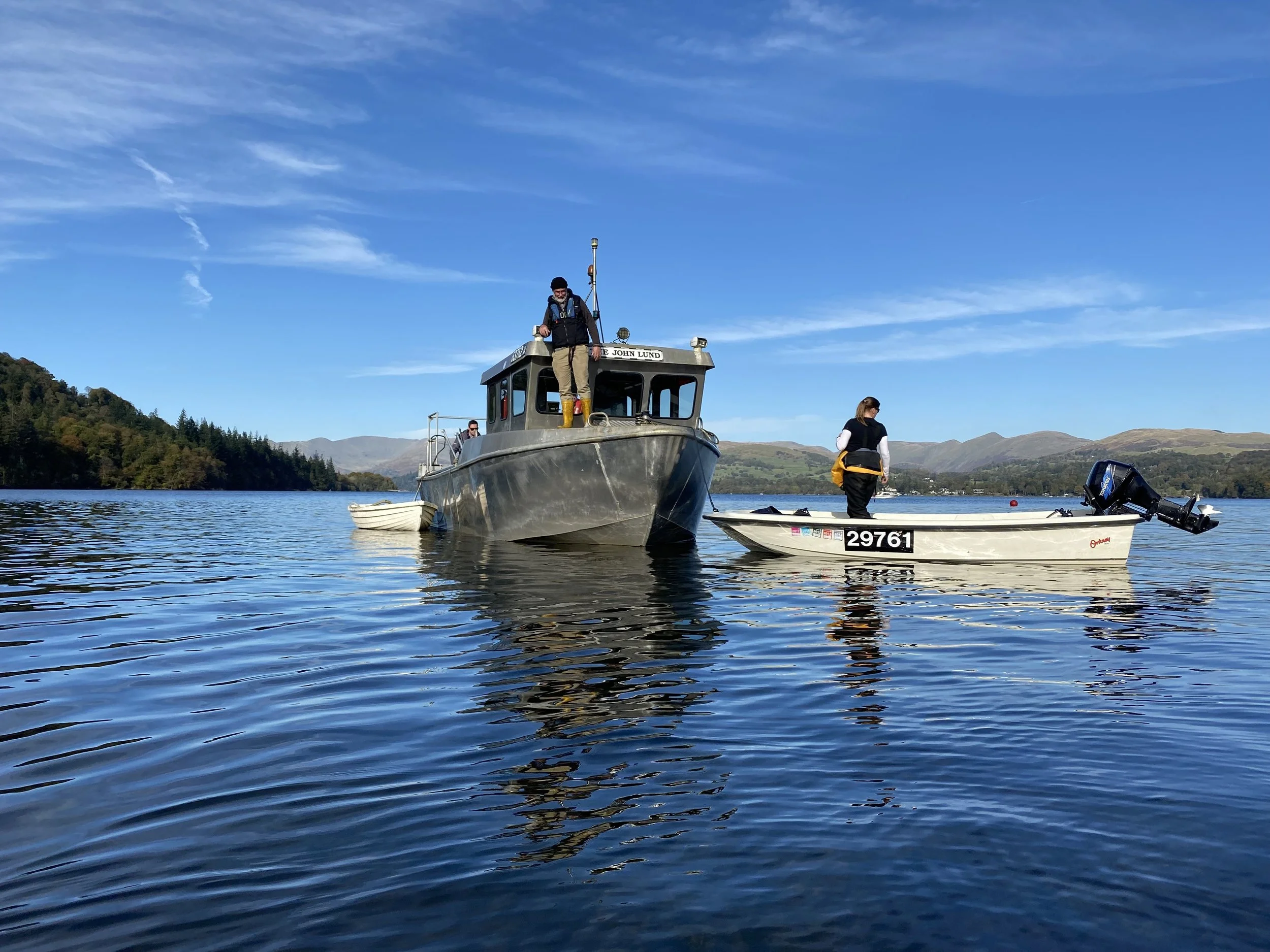
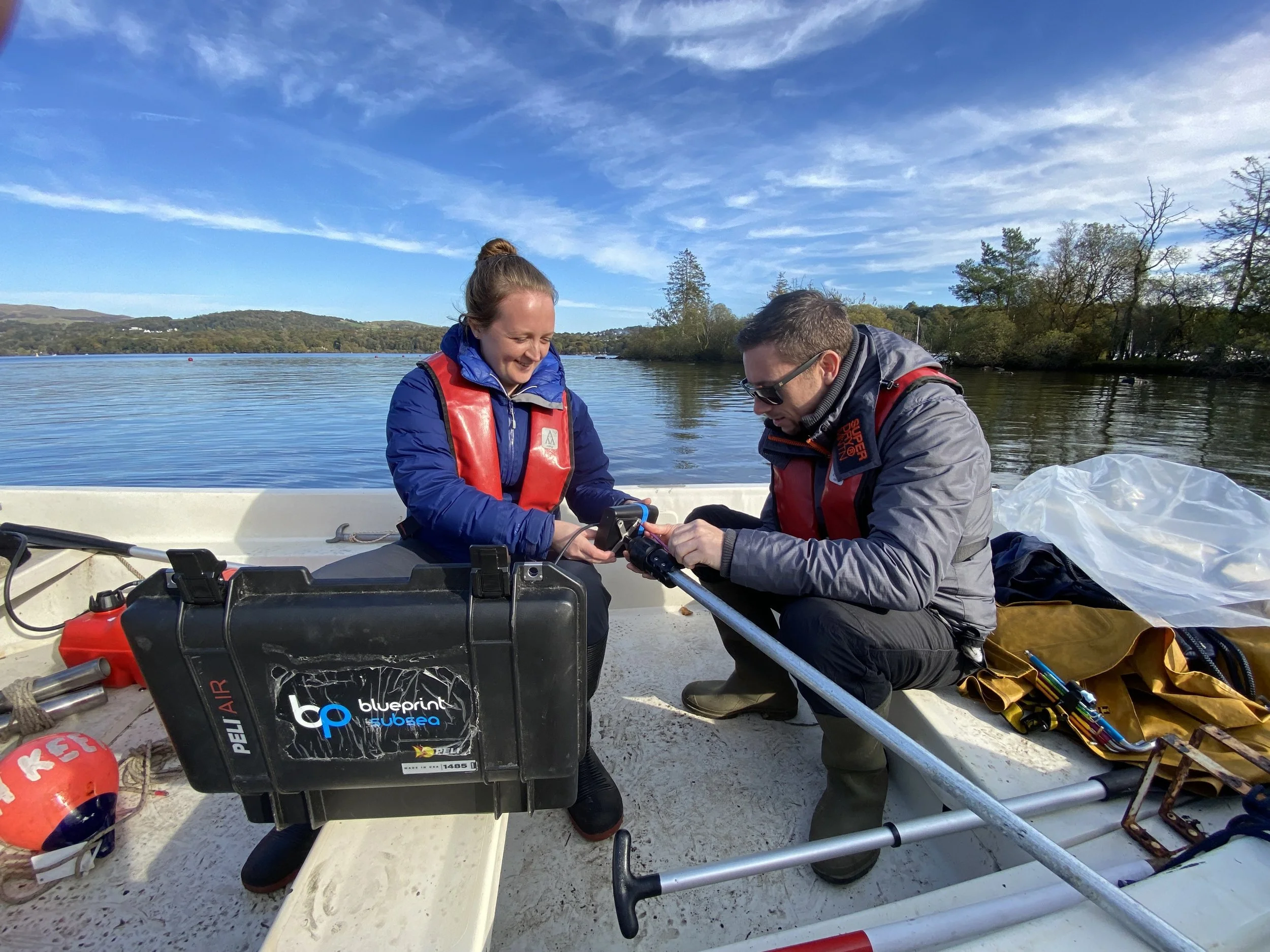
Photos of the LD-CHARM research boat (left), and some of the team out on Windermere for the 1st Oculus Trial in October 2024 (right).
Working together to secure the future of Arctic charr
The LD-CHARM partnership brings together scientific expertise, historical datasets and local knowledge to develop a coordinated approach to Arctic charr conservation in England. The latest findings underline the importance of collaborative, evidence-led conservation and the need for urgent action to protect the future of this remarkable species.
“Freshwater biodiversity is under increasing pressure at a global scale, and Windermere’s Arctic charr populations are a local example of this bigger picture. To understand the multiple threats facing freshwater wildlife, we must continue to work collaboratively, integrating established and novel research methods, which then guides management action.”
England’s Ice Age Survivor: Introducing the Lake District Arctic charr
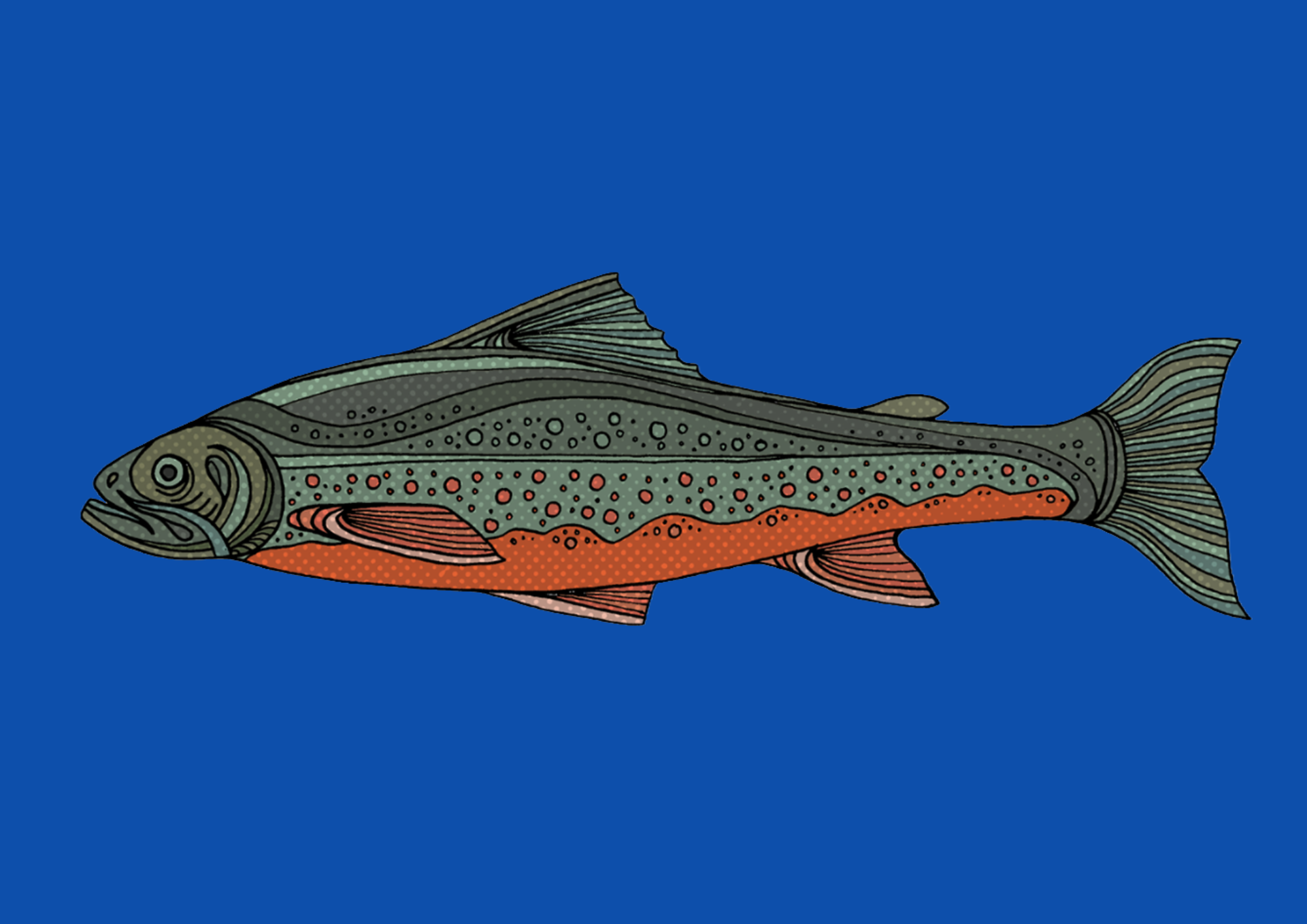
Illustration of the stunning, iconic Lake District Arctic charr, one of England's oldest native freshwater fish species, resplendent in distinctive spawning colours.
With thanks to Natural England for funding this work through their Species Recovery Programme, the Environment Agency for additional funding and to local charr fishers for supporting the project. Many thanks to Lindsay McCrae for the amazing Arctic charr photography.
The LD-CHARM partnership
LD-CHARM is a unique collaboration between the FBA, Natural England, UK Centre for Ecology & Hydrology, University of the Highlands and Islands (UHI Inverness), University of Glasgow, the Environment Agency, Lake District National Park Authority, Institute of Fisheries Management and industry specialists, alongside invaluable contributions from local fishers and communities.
By combining state-of-the-art science, decades of data and expertise, and local knowledge, the partnership is uniquely positioned to deliver meaningful conservation outcomes for the Arctic charr.
About the Natural England Species Recovery Programme
Natural England’s Species Recovery Programme (SRP), launched in 1991 and funded by Defra, is one of England’s longest-running conservation initiatives. It has helped recover over 70 endangered species, including the large blue butterfly, red kite, and pool frog. The programme delivers targeted conservation through partnerships with academics, NGOs, landowners, and local communities.
Arctic charr documentary
Simon Johnson, Executive Director of the Freshwater Biological Association features in a new documentary, filmed by BAFTA-winning cinematographer Lindsay McCrae and created by Save Windermere. The documentary called EXTINCTION explores our relationship with the natural world, the consequences of environmental decline and, ultimately, what is at stake if we fail to act.
Interested in discovering more?
Find out more about the LD-CHARM Research Findings 2026 and download the summary report, ‘England’s Ice Age Survivor: Conserving Arctic charr in the Lake District’.
Discover more about the Lake District Charr Recovery and Management (LD-CHARM) project and partnership.
Read: Species on the edge: Arctic charr at the southern extent of its range, 13 May 2025. Here, Louise Lavictoire, the FBA’s Head of Science, and colleagues introduce Lake District Charr Recovery and Management (LD-CHARM), a new project that seeks to inform protection of threatened populations of the Arctic charr.
Read: Charming the Charr, July 2025. In this article Simon Johnson, Executive Director of the Freshwater Biological Association, talks about the LD-CHARM project and partnership, “a coalition of rare-fish ecologists, scientists and ‘crazies’ in the Lake District who are fighting to save one of our most special native fishes”.
Reproduced with kind permission from the Wild Trout Trust, and first appeared in the Wild Trout Trust’s Salmo Trutta 2025.