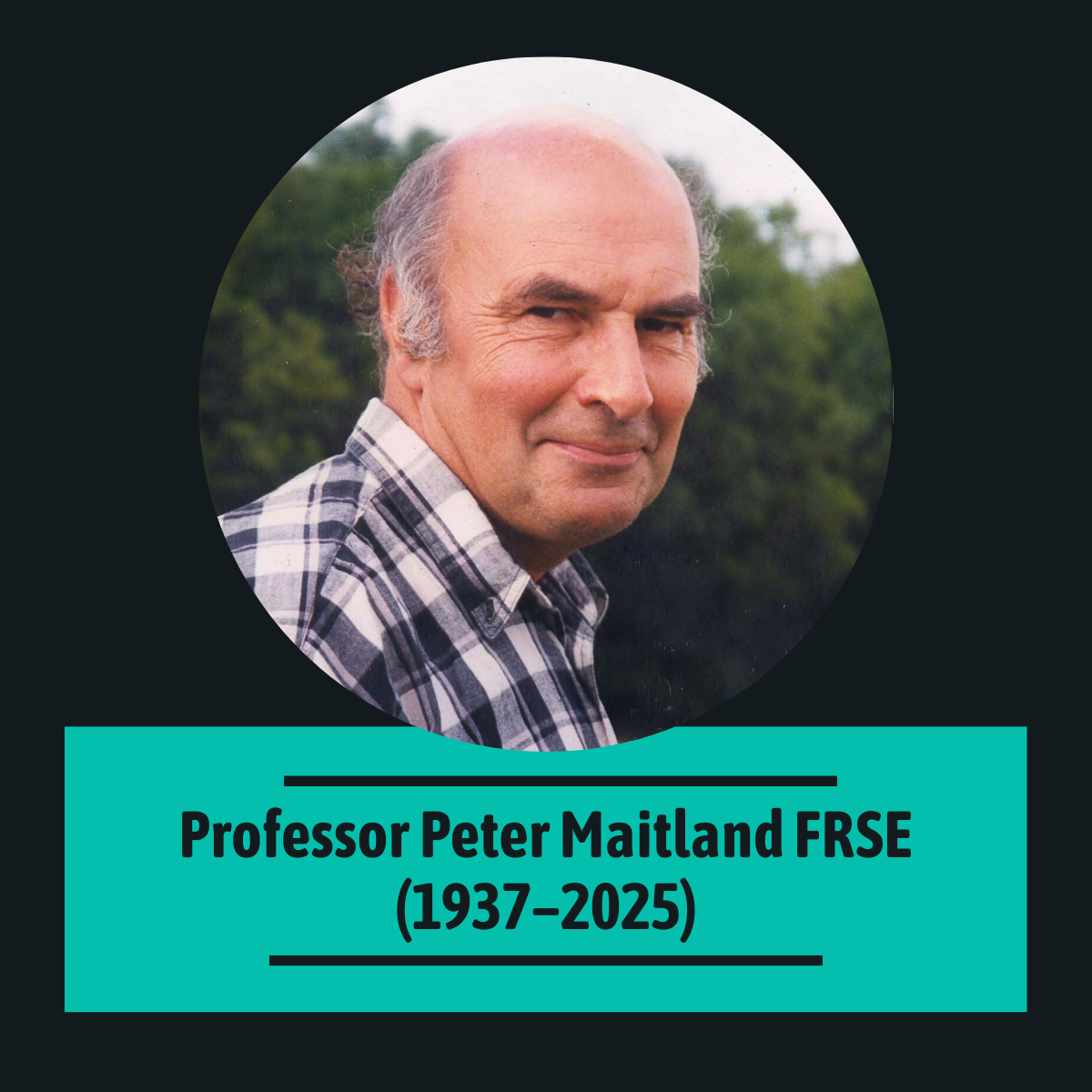
Obituary: Professor Peter Maitland FRSE (1937–2025)
9 December, 2025
The freshwater science community has lost one of its most respected and influential members with the passing of Professor Peter Maitland FRSE on 24 November 2025. He was aged 87.
A prolific scientist and writer, with 260 scientific papers and 15 books, Peter’s name will be well known to those who have an interest in all aspects of freshwater science and conservation policy. It is perhaps fair to say that most scientific libraries will have several of his publications on their shelves.
Remembering Peter’s formidable freshwater science career
Peter’s career in aquatic science fully started in 1959 when, following degree studies at the University of Glasgow, he embarked on a PhD project which described the distribution and ecology of the invertebrate fauna within the River Endrick, a major tributary of Loch Lomond. Working within the Loch Lomond catchment, it was perhaps inevitable that Peter would take a keen interest in the ecology of Loch Lomond’s diverse freshwater fish community, which included both the powan (Coregonus lavaretus), known as schelly in England and gwyniad in Wales, and a rare freshwater-resident population of river lamprey.
His interest in rare freshwater fish species within Great Britain persisted throughout his career, but in truth he was no less interested in all freshwater fish which have been recorded in our freshwaters. This is evidenced by his authorship of seven books which directly addressed the ecology and distribution of freshwater fish in Scotland, and Great Britain.


Photos by Johan Hammar showing: (1) Peter Maitland standing next to a few Arctic charr scientists (including ex FBA PhD student Elly Baroudy) as they make their way to Cumbria during a visit of the International Society of Arctic charr Fanatics (ISACF) in 1992. (2) Peter Maitland with his late wife (Kathleen) and colleagues in front of the Fish Hotel, Buttermere, in the Lake District during the ISACF workshop 1992.
An advocate for freshwater conservation policy
Not so often appreciated, however, was Peter’s input to the development of freshwater conservation policy. Appointment to the position of scientific leader of the Wetlands Research Group for the Nature Conservancy (a forerunner of NatureScot) in the late 1960s, made him the perfect choice to lead and coordinate the work programme for the multidisciplinary Loch Leven IBP Research Project. This major undertaking, which included input from 50 scientists from 15 research institutes, eventually took him in 1974 to the Natural Environment Research Council (NERC) Institute of Terrestrial Ecology (ITE) as their scientific leader of the Freshwater Research Group. There he became a leading voice in the study of freshwater ecosystems, working on acidification impacts, species distributions and site condition assessment.
It was during this time that Peter also played a pivotal role in identifying the criteria that would be used for identifying species of high conservation value and the selection of important sites for freshwater fish in the British Isles. These were used to develop the network of Sites of Special Scientific Interest for freshwater fish that exists today.
In 1987 Peter decided to break from his organisational role and he left the ITE to set up his own independent consultancy, the Fish Conservation Centre. This move did not diminish his scientific output or his role in the development of freshwater policy. Serving on committees and boards for a range of statutory agencies, like the Forestry Authority, Scottish Natural Heritage and Scottish Environment Protection Agency (SEPA), as well as the IUCN (International Union for Conservation of Nature), NERC and eNGOs, Peter retained an ability to guide and influence the freshwater policy landscape at a national, and international level.
He successfully lobbied for greater legislative protection for freshwater fish, and within the Scottish Wildlife Link and Angling for Change group provided the foundation for a major government review of the way in which freshwater fish and fisheries are managed in Scotland. Had political nerves held out, this would have radically changed the management landscape for freshwater fish in Scotland.
In Alaska with the International Society of Arctic charr Fanatics (ISACF) in 1996

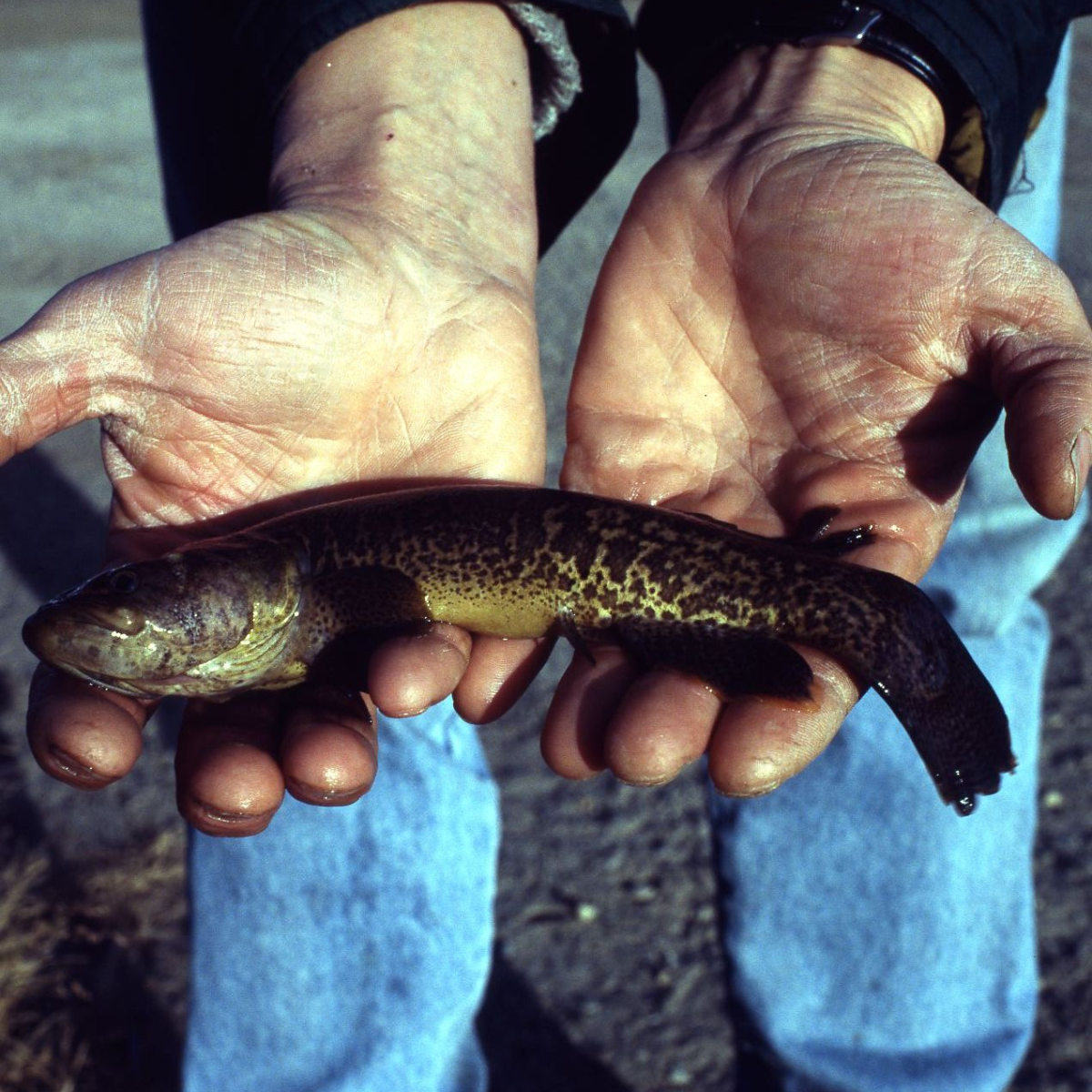
Photos by Johan Hammar showing (left) Peter Maitland together with Pavel Gudkov (Russia) and Fred Kircheis (Maine) in Nome, Alaska, hoping to catch Dallia pectoralis after the ISACF workshop in 1996, and (right) Dallia pectoralis.
At the Scottish Centre for Ecology and the Natural Environment (SCENE) in 2016

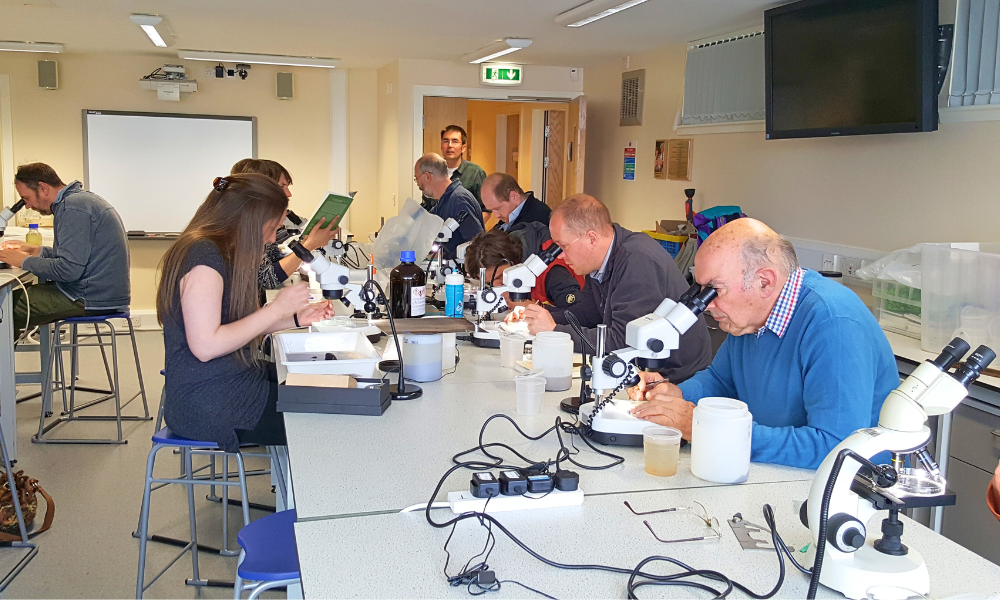
Past presidents of the Scottish Freshwater Group Peter Maitland with Laurence Carvalho (FBA Fellow) & Colin Adams (left), and Peter Maitland and colleagues in a lab during a Loch Lomond Bioblitz in 2016 (right).
A lasting legacy of freshwater publications
A perusal of Peter’s commendably long and varied publication list shows that he possessed the rare ability to integrate detailed field observation with ecological synthesis for an astounding array of freshwater fauna. A true natural historian, Peter was also able to augment his research into the historical distribution of species by expertly trawling through reports, news articles and miscellanea that, in the modern digital age, may have been lost forever.
Peter had a long association with the Freshwater Biological Association and, as well as serving on the FBA Council from 1977-1980, he also authored two extremely popular FBA keys to the freshwater fishes of the British Isles, with notes on their distribution and ecology. In recognition of his standing in the field of aquatic science, he was awarded fellowships from the Royal Society of Edinburgh (1980), the Royal Zoological Society of Scotland (1996) and was awarded the Neill Medal from the Royal Society of Edinburgh (1993), the Beverton Medal from the Fisheries Society of the British Isles (1996) and the Marsh Conservation Award from the Zoological Society of London (1999). He was also awarded an FBA Honorary Fellowship in 1999.

Peter Maitland and Colin Bean sampling the rare Arctic charr and Powan fish community in Loch Eck in 1993.
“Peter leaves a legacy that is both scientific and personal. His keys remain on our shelves and in our field packs; his reports continue to guide conservation action; and his approach to science which was quiet, collaborative and meticulous remains a model for all who work in freshwater ecology. The FBA has lost a committed supporter and friend, and he leaves a community of colleagues who will remember him with deep respect, gratitude and admiration.”
The wealth of knowledge that Peter accrued throughout his career was much sought after by fellow scientists and students. Peter was known not only for his expertise but for his extraordinary generosity with his time, datasets and field experience. Long before open data became a norm, Peter freely shared his notebooks, raw data, survey results, and practical insights with colleagues and students. His desire to educate and promote new scientific talent was clear and his involvement in the development, and longstanding support of, the Scottish Freshwater Group was a strong testament to that.
Peter leaves a legacy that is both scientific and personal. His keys remain on our shelves and in our field packs; his reports continue to guide conservation action; and his approach to science which was quiet, collaborative and meticulous remains a model for all who work in freshwater ecology. The FBA has lost a committed supporter and friend, and he leaves a community of colleagues who will remember him with deep respect, gratitude and admiration.
Professor Colin Bean – FBA Honorary Life Fellow
Interested in discovering more?
Key to Freshwater Fish of Britain & Ireland by Peter Maitland in the FBA shop.