Lakefly – a new citizen science project to help monitor the health of our lakes
5 November, 2025
Lakefly is a new citizen science project developed by the Freshwater Biological Association (FBA) in partnership with Natural England (NE), and funded by Defra’s Natural Capital and Ecosystem Assessment (NCEA) programme.
Using a simple sampling method and easy-to-learn identification guide, Lakefly is empowering volunteers to fill a critical gap in freshwater monitoring.
Why is a citizen science project like Lakefly so important?
While rivers are routinely surveyed through schemes like Riverfly, most UK lakes (especially smaller ones) aren’t regularly monitored. Lakefly engages volunteers to assess lake health by sampling shoreline invertebrates, which act as indicators of water quality and ecological change.
Lakes provide essential ecosystem services (clean water, flood regulation, biodiversity, and recreation) but they are widely under-monitored. By training citizen scientists to identify key invertebrate groups, Lakefly creates an early warning system for pollution events or widespread ecological degradation, while also connecting people to the lakes they care about, and one another.
The project additionally helps fill national evidence gaps and supports more informed conservation and management decisions.


The Bassenthwaite Lakefly training day in October with the Lake District National Park Authority.
Background on the recent pilot phase
The Lakefly Pilot (2025) has focused on testing and refining the new monitoring method.
Key achievements include:
Development of a complete training package, including an online pre-training module, a detailed field guide, and a biotic indicator scoring system based on adapted WHPT (Whalley, Hawkes, Paisley & Trigg) biotic assessment indices.
Successful pilot training sessions across the UK, including Cumbria, Kent, Cheshire, Dorset, and Wales, covering 11 different lakes. Registered sampling sites can be viewed on this map.
43 trained volunteers, including members of the public, some of which had no prior experience in freshwater monitoring or invertebrate ID and staff from Lake District National Park, Natural England and Environment Agency officers, and Angling Trust.
The method has proven accessible even for beginners, thanks to clear online training, in-person training and ongoing support. Feedback from organisations has been overwhelmingly positive – there is now a waiting list of groups keen to join in spring 2026!
“Lakefly helps to address a key evidence gap in freshwater monitoring, targeting lake habitats that are often underrepresented in existing surveys.
Lakefly is testing how monitoring pollution-sensitive shoreline invertebrates can act as an early warning system for water quality issues and ecological degradation. We hope that, over time, this approach will also help identify spatial hotspots and landscape-scale pressures to better support lake management and restoration. Lakefly can also be overlaid with other professional and citizen science monitoring methods, which can validate findings and build a holistic understanding of lake condition. But citizen science is about more than data. Lakefly also helps people reconnect with freshwater habitats – building knowledge, scientific skills, and confidence through hands-on learning based on professional methods. In doing so, it supports communities to take an active role in stewardship and advocacy for the lakes they care about.”
Key findings so far from this pilot phase of Lakefly
The Lakefly method is proving accessible, practical and scientifically robust, even for volunteers without prior freshwater or invertebrate experience.
The adapted Lakefly scoring system seems to initially perform well when applied to existing Environment Agency datasets.
Volunteers found the method engaging and empowering, reporting a strong sense of childlike fun and connection to freshwater ecosystems during the training day.
Some challenges have included fine-scale identification (due to small invertebrates) and kit costs, but solutions such as tray magnifiers, equipment loans, and partnerships with Riverfly hubs are addressing these.


Ullswater Lakefly training day in September with the Friends of the Ullswater Way.
What’s next for Lakefly?
Launch of a dedicated Lakefly data platform on Cartographer (live by March 2026).
Completion of data analysis of pilot results, this will inform on how the biotic scoring method is working, provide insights into how the data could be used. These insights will help us to refine the method for maximum relevance and impact.
Expansion of the network of trained volunteers and development of regional Lakefly hubs, based on the successful Riverfly model.
Exploration of independent funding and cross-border collaborations with partners such as Buglife, the Scottish Environment Protection Agency (SEPA), Natural Resources Wales (NRW), Northern Ireland Environment Agency (NIEA).
Continue engaging with volunteers through our monthly Lakefly newsletters and hosting of a feedback webinar for participants later this year.
“Developing the Lakefly training materials and supporting volunteers throughout the pilot has been incredibly rewarding. It’s been fantastic to see participants build confidence in identifying lake invertebrates, and their willingness to share results has shown just how much citizen science can achieve when people are given the right tools and guidance. The growing interest and engagement from volunteers really highlights the potential of Lakefly to transform lake monitoring and stewardship across the UK. I’m excited to see the Lakefly community continue to grow as we move into the next phase of the project.”
Lakefly in action on Ullswater
The Ullswater Lakefly Citizen Science water quality testing in launched.
Following on from the FBA Lakefly training in September, citizen scientists carried out the first Lakefly water quality monitoring in October at a shoreline site managed by the Ullswater Steamers in Glenridding.
The Ullswater Lakefly Citizen Science project was conceived in February this year by the Friends of the Ullswater Way (FOUW) in consultation with a range of local and national institutions, including the Ullswater Association, Dalemain, the Outward Bound Trust, Patterdale Hall, the Freshwater Biological Association (FBA), National Trust, LDNPA and the Environment Agency.
An online survey conducted by FOUW in July /August this year showed that local people were very keen to understand more about water quality and biodiversity issues in Ullswater and were willing to participate in a monitoring programme. Within the framework of this project 12 volunteers have so far been trained in the Lakefly methodology established by the FBA.
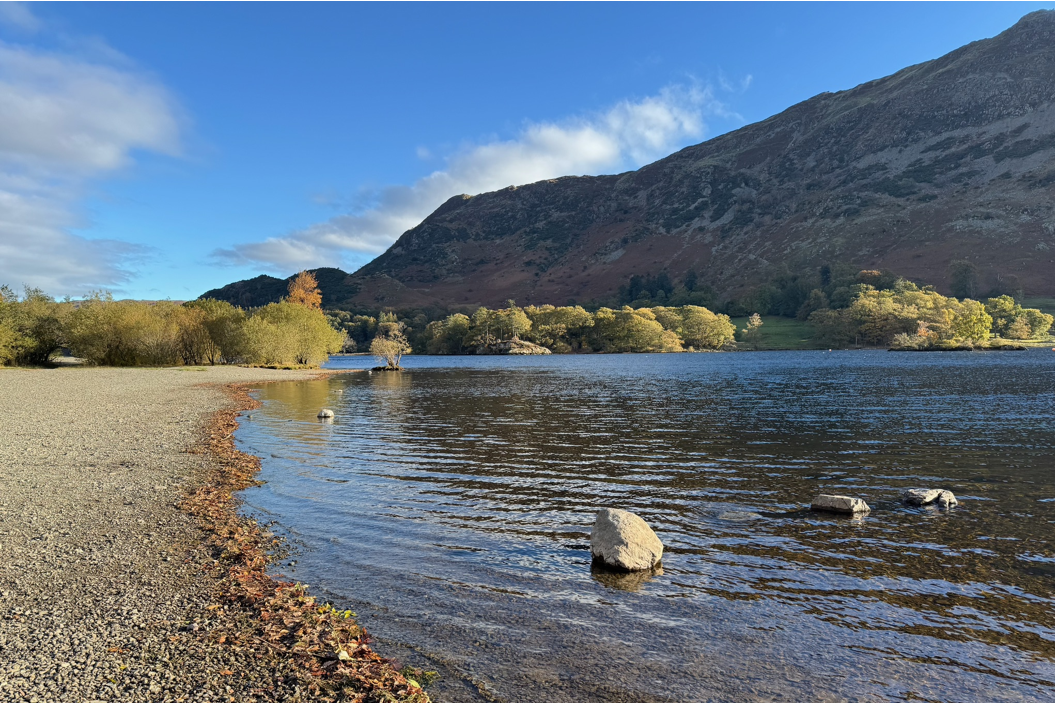
Ullswater in the Lake District, Cumbria. Photo credit Friends of the Ullswater Way.
“It’s great fun, it attracts a lot of interest from passers-by, and over the course of the year should tell us a lot about the ecology of Ullswater. It’s exciting to be part of this new initiative.”


Tim and Anne Clarke, both FOUW Trustees, did the first Ullswater sampling on 25 October, and are very enthusiastic about the Lakefly project.
Many thanks to all the Lakefly funders and supporters including Natural England, Defra's Natural Capital Ecosystem Assessment programme, the Lake District National Park Authority (LDNPA), the Angling Trust, and Friends of the Ullswater Way.
How can people get involved?
Currently, the project is in the middle of a comprehensive pilot phase and no more training events are planned, however we anticipate Lakefly going ‘live’ in Spring 2026.
Individuals or organisations interested in joining future training can register their interest via the Lakefly email (lakefly@fba.org.uk). New training opportunities will be announced in early spring 2026.
Interested in discovering more?
Find out more about the Lakefly citizen science project.