Understanding chemical impacts on freshwater microbial communities
20 November, 2025
Holly Tipper*, Amy Thorpe, Daniel Read and partners, on behalf of the PACIFIC consortium.
UK Centre for Ecology & Hydrology (UKCEH)
Holly is a Senior Molecular Microbiologist, Amy is a Molecular Ecologist and Dan is an Associate Science Director at UKCEH. Here, they report their work on the PAthways of Chemicals Into Freshwaters and their ecological ImpaCts (PACIFIC) project, which is investigating how human-made chemicals enter freshwater ecosystems and the impacts they have, particularly on microbial communities.
Edited by Rachel Stubbington, Nottingham Trent University
Rachel is both a Fellow of the Freshwater Biological Association and long-standing Editor of FBA articles. If you would like to submit an article for consideration for publication, please contact Rachel at: rachel.stubbington@ntu.ac.uk
Introduction
Freshwater ecosystems face increasing pressures from pollution, habitat degradation, and climate change (Van Vliet et al. 2023), leading to declines in freshwater species and the services these ecosystems provide. Monitoring these pressures is challenging, as stressors such as chemical pollution can occur in pulses, linked to events like heavy rainfall or wastewater discharges, or be released from diffuse sources, such as agricultural runoff.
While research has traditionally focused on the impacts of chemicals on fish, macroinvertebrates, and aquatic plants, far less is known about their effects on freshwater microbes, the unseen foundation of ecosystem health. Microbial communities, also known as the ‘microbiome’, comprise millions to billions of cells per millilitre of water or gram of sediment. They are a biodiverse and functionally important component of freshwater ecosystems, breaking down pollutants, forming the base of food webs, and driving nutrient cycling, thus playing a major role in greenhouse gas cycling (Premke et al. 2022). Understanding how chemical stressors affect these communities is crucial for predicting their broader ecosystem impacts.
The NERC PACIFIC Project
Thousands of chemicals used in modern life ultimately enter freshwater systems – whether through treated or untreated wastewater discharges or runoff from agricultural and urban land – where they interact in complex, often unpredictable ways, disrupting organisms and ecosystems.
The “PAthways of Chemicals Into Freshwaters and their ecological ImpaCts (PACIFIC)” project is one of five projects in the Understanding Changes in Quality of UK Freshwaters programme funded by the UKRI Natural Environment Research Council (NERC). Led by the UK Centre for Ecology & Hydrology (UKCEH) in collaboration with the University of Bath, University of Oxford and the Environment Agency, PACIFIC runs from November 2022 to October 2026, and aims to understand how human-made chemicals enter freshwater ecosystems, specifically rivers, and the impacts they have, with a particular focus on microbial communities.
In particular, PACIFIC is investigating the relationship between predicted chemical pathways and measured concentrations in water and sediments across multiple UK river catchments. Advances in DNA sequencing technologies mean that we can now characterise whole microbial ecosystems in unprecedented detail, generating millions of sequencing reads in a single run, providing large genetic datasets at relatively low cost. Our research uses this genetic analysis alongside analytical chemistry and modelling approaches. By taking a multifaceted approach combining catchment-scale monitoring, semi-controlled multi-stressor experiments and predictive modelling, we aim to comprehensively understand the impacts of chemicals on microbial communities and ecosystem function (Figure 1).
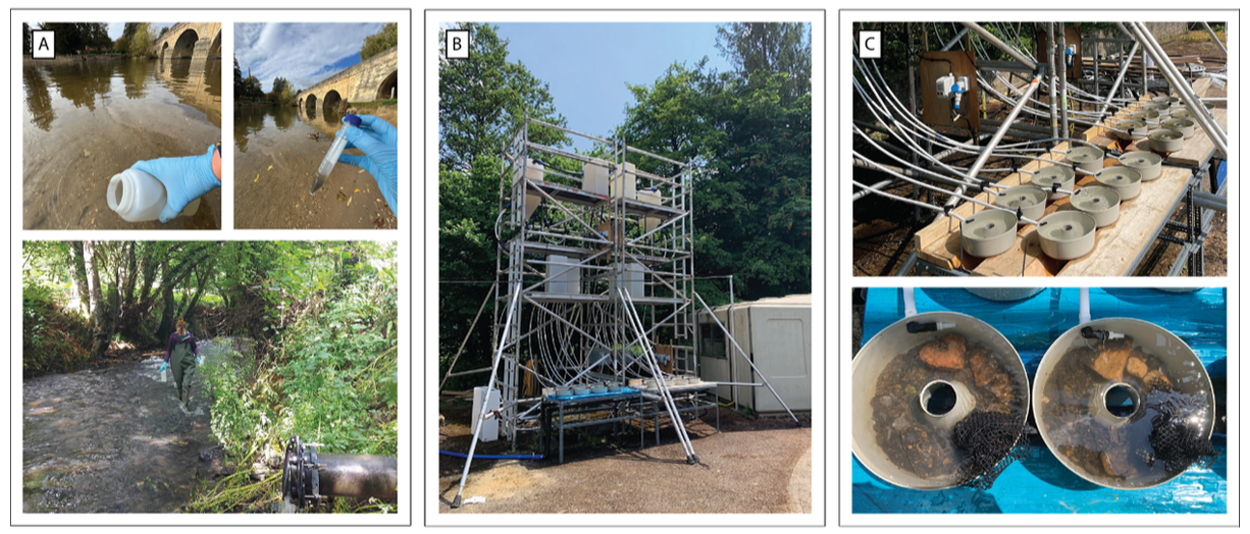
Figure 1. (A) Catchment-scale sampling of freshwater microbial communities. (B) Full setup of “ExStream” style semi-controlled multi-stressor experimental mesocosms, and (C) close-ups of the mesocosms.
Our research under the PACIFIC project has included intensive monitoring in catchments, specifically in the Bristol-Avon river catchment, generating samples to which we have applied advanced molecular and chemical methods, including metagenomic sequencing, quantitative polymerase chain reaction (qPCR), liquid chromatography, and mass spectrometry, to link chemical inputs to microbial responses. Sampling sites were located in areas with contrasting land uses, such as agricultural and urban settings, and some were upstream or downstream of wastewater treatment works, to assess how land management and treated sewage effluent might influence chemical burdens.
Alongside field sampling, we have established experimental riverside mesocosms (Figure 1B) in partnership with Wessex Water, to investigate the impacts of multiple stressors on sediment and biofilm microbial communities, as well as invertebrates. These controlled yet ecologically realistic systems, based on the “ExStream” system, consist of replicate circular mesocosms supplied by river water from gravity-fed header tanks. This setup can be manipulated to introduce multiple stressors, such as elevated temperatures and chemical inputs, providing powerful insights into ecosystem-level responses to complex, multi-stressor exposures.
To complement field and experimental work, we are developing predictive models of diffuse and point-source chemical pollution pathways. These models incorporate future hydrological, climate, and socio-economic scenarios and will be informed by responses observed in our experiments. This integrated approach will allow us to identify emerging threats to freshwater ecosystems and their microbiomes under changing environmental conditions. Additionally, our collaborative research with the Environment Agency on sequencing DNA from riverine biofilms collected from across England is being used to understand the taxonomic and functional dynamics of these microbial communities at a national scale.
River microbial communities at a national scale
As part of PACIFIC, we carried out the first national-scale assessment of microbial biofilms in rivers and streams across England, using over 1,600 samples collected since 2021 from 700 sites in the Environment Agency’s River Surveillance Network (Figure 2A; Environment Agency, 2024; Thorpe et al., 2025a, 2025b). Biofilms comprise complex microbial communities attached to submerged surfaces which allows the microbes to persist in the river longer than those in the water column. This persistence means that biofilms can integrate environmental signals over space and time, capturing both local conditions and broader catchment inputs. As a result, they act as powerful indicators of ecological change. Yet until now, large-scale patterns in their composition, diversity and functions have remained poorly understood.
In our national biofilm survey, we reconstructed 1,014 bacterial genomes, revealing a remarkable diversity that includes many previously undescribed microbial taxa. The phylogenetic tree of these genomes highlights the dominant bacterial groups and the evolutionary relationships among them (Figure 2B).
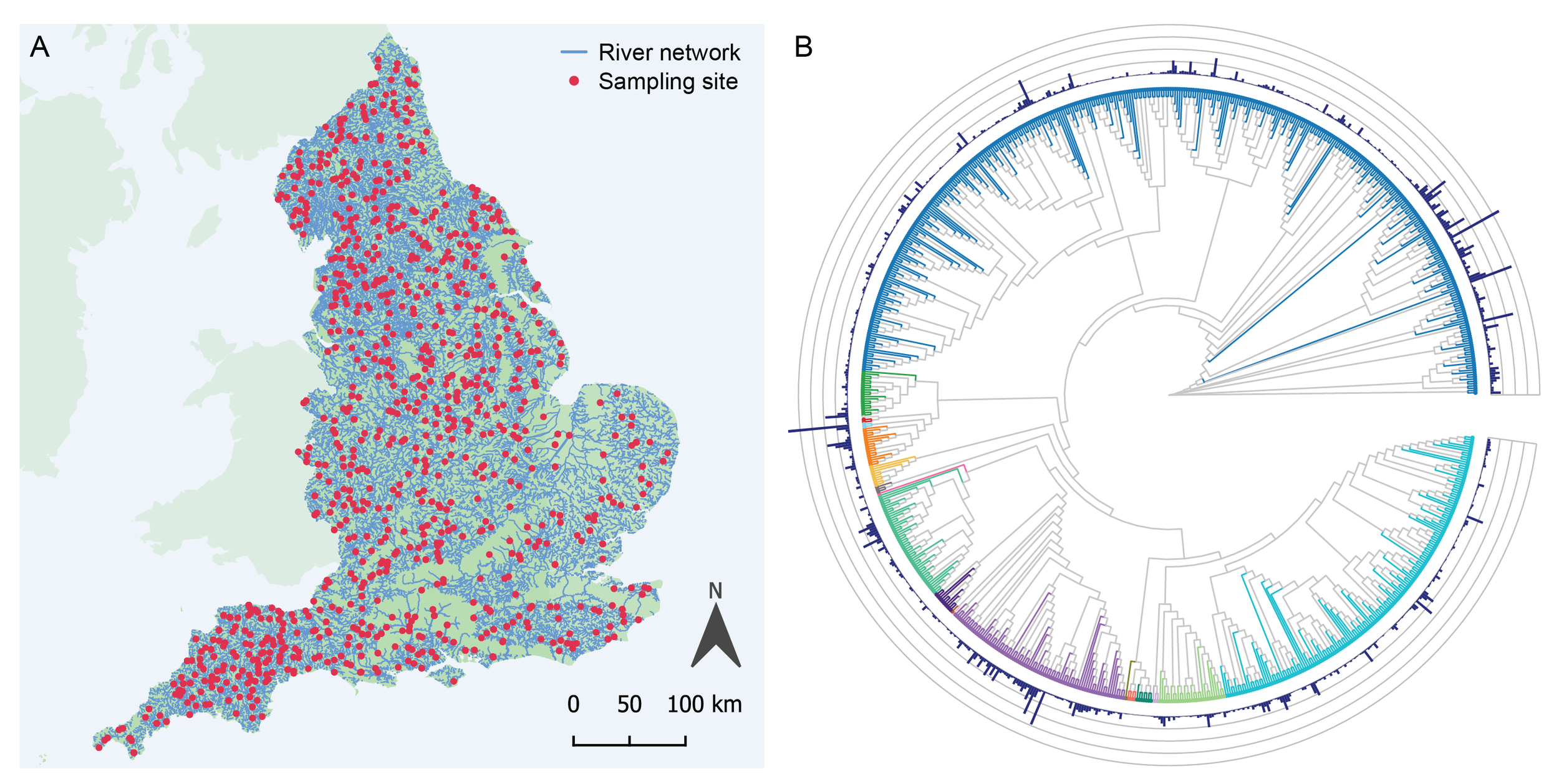
Figure 2. (A) River biofilm sampling sites across England. (B) Phylogenetic tree showing the diversity of the bacterial genomes identified. Colours indicate different taxonomic groups, and the outer bars represent their abundance in river biofilms.
Biofilm bacteria proved to be metabolically versatile, carrying genes that enable the degradation of a wide variety of organic compounds, reflecting their ability to process inputs from diverse sources. They also encoded genes for carbon and nitrogen cycling, facilitating the transformation and mobilisation of nutrients and energy through aquatic food webs (Figure 3). Genes linked to antimicrobial resistance and contaminant breakdown were widespread, suggesting that biofilms act as important hotspots for anthropogenic chemical processing. The presence of antimicrobial resistance genes in biofilms may contribute to the persistence and spread of antimicrobial resistance in rivers and the wider environment.
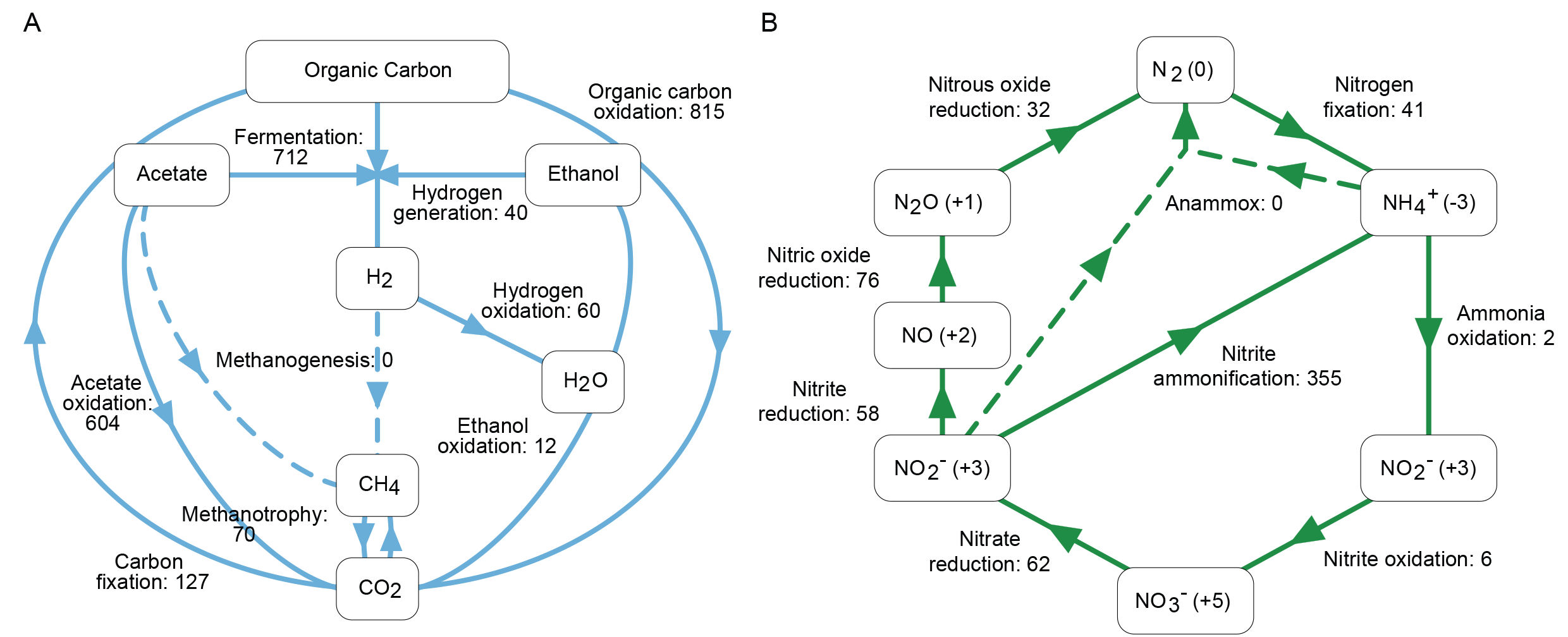
Figure 3. River biofilm bacteria contributing to (A) carbon and (B) nitrogen cycling pathways, where numbers show how many of the 1,014 bacterial genomes contain genes involved in each process.
Environmental factors, predominantly geology, land use and nutrient concentrations, strongly shaped biofilm bacterial community composition. Spatial structuring across England reflected clear environmental gradients, and revealed functional redundancy, i.e. the occurrence of multiple microbes with comparable functional roles. This redundancy could enable biofilms to maintain key ecosystem functions even as community composition shifts, conferring resilience to environmental change.
This work establishes a critical baseline for understanding microbial diversity and function in rivers, highlighting biofilm microbes as key players in maintaining ecosystem health and potentially mitigating pollutants. It underscores the importance of integrated management strategies that consider how land use impacts the microbial processes underpinning freshwater ecosystem functions.
Looking ahead
The PACIFIC project is continuing to uncover how chemical stressors influence freshwater ecosystems and will keep generating valuable insights through to its completion in autumn 2026, and beyond. Our next steps include comparing microbiome-based indicators with traditional bioindicators to evaluate whether microbial metrics can offer more sensitive indications or earlier warnings of ecosystem stress. We are also investigating a suite of DNA markers, including those linked to pathogens, antimicrobial and metal resistance genes, and source indicators, to develop robust approaches for assessing ecosystem health and to build a deeper mechanistic understanding of the drivers of microbial community change from multiple stressors.
By integrating field observations, experimental data and advanced predictive models, we aim to provide policymakers and water managers with robust tools to safeguard biodiversity and ecosystem functions in a changing world. Together, these combined efforts will strengthen biomonitoring and predictive modelling, enabling us to anticipate emerging threats and mitigate their impacts on freshwater ecosystems and their microbiomes.
Acknowledgements
The PACIFIC project was funded by the Natural Environment Research Council, under grant numbers NE/X015947/1, NE/X015890/1, NE/X015777/1 and NE/X015874/1, and the Environment Agency Science Project SC220034.
References
Environment Agency 2024. Molecular data generation and preliminary analysis of river microbial biofilm communities. https://www.gov.uk/government/publications/molecular-data-generation-and-preliminary-analysis-of-river-microbial-biofilm-communities
Premke, K. et al. 2022. Large-scale sampling of the freshwater microbiome suggests pollution-driven ecosystem changes. Environmental Pollution 308: 119627. https://doi.org/10.1016/j.envpol.2022.119627
Thorpe, A. C. et al. 2025a. National-scale biogeography and function of river and stream bacterial biofilm communities. bioRxiv. https://doi.org/10.1101/2025.03.05.641783
Thorpe, A. C. et al. 2025b. River biofilm bacteria as sentinels of national-scale freshwater ecosystems. bioRxiv. https://doi.org/10.1101/2025.11.03.686311
Van Vliet, M. T. et al. 2023. Global river water quality under climate change and hydroclimatic extremes. Nature Reviews Earth & Environment 4: 687–702. https://doi.org/10.1038/s43017-023-00472-3
Further reading
Find out more about the Pathways of Chemicals to Freshwaters and Their Ecological Impacts (PACIFIC) project.
Further FBA reading
The Freshwater Biological Association publishes a wide range of books and offers a number of courses throughout the year. Check out our shop here.




Get involved
Our scientific research builds a community of action, bringing people and organisations together to deliver the urgent action needed to protect freshwaters. Join us in protecting freshwater environments now and for the future.

NEW COURSE: Pond Restoration Training: North West England on 6 & 7 July 2026. From £250.00
Ponds are increasingly recognised as critical features for biodiversity conservation across UK landscapes. This two-day course will introduce participants to the science and best practice of pond restoration.
Helen Greaves of the Pond Restoration Research Group at University College London (UCL) is a co-founder of the Norfolk Ponds Project (NPP) and Executive Director of the NPP Community Interest Company (CIC). With over 15 years’ experience restoring ponds and researching their ecological recovery, and following publication of the recent Guide to the Restoration, Creation and Management of Ponds, Helen is keen to share key lessons and practical insights from both the UCL and NPP teams.
The course will include a combination of lectures, workshops, and field visits focused on the restoration of degraded overgrown ponds and in-filled “ghost ponds”.
Participants will be introduced to the scientific evidence underpinning pond restoration, including the benefits for freshwater and terrestrial biodiversity. The course will also cover the key DOs and DON’Ts of restoration, including pond selection and important considerations during the restoration process.
Field visits will explore two contrasting pond landscapes typical of West Lancashire. One site is situated within a lowland floodplain landscape, while the other lies within a higher arable setting adjacent to a nature reserve. These visits will provide an opportunity to compare ponds across different land uses, including farmland and conservation-focused landscapes. Participants will consider how landscape context influences restoration potential, management approaches, and ecological outcomes, including the specific challenges and opportunities associated with restoring existing ponds and resurrecting ghost ponds.
The course will also address approaches to engaging landowners, farmers, and local communities in pond conservation, alongside practical routes for securing funding to support restoration work.
Participants on all FBA courses must be 18 years and above.
Location: West Lancashire (near Ormskirk)
Tutor: Helen Greaves
Price: £275 for non-members, £250 for members
Please click on the following link to download and complete the booking form then email to info@fba.org.uk: FBA Courses Booking Form.docx
TO AVOID POSTAL CHARGES PLEASE SELECT ‘PICK UP’ OPTION AT CHECKOUT.
Please note: Payment must be made in full via the website in order to secure your place on this course.