The fourth Big Windermere Survey results (Jun, 2023)
28 June, 2023
Freshwater Biological Association announces results of fourth Big Windermere Survey
The Freshwater Biological Association is delighted to share the results of our fourth Big Windermere Survey, which provides an intensive snapshot of water quality within the Leven catchment on one day, in the spring season.
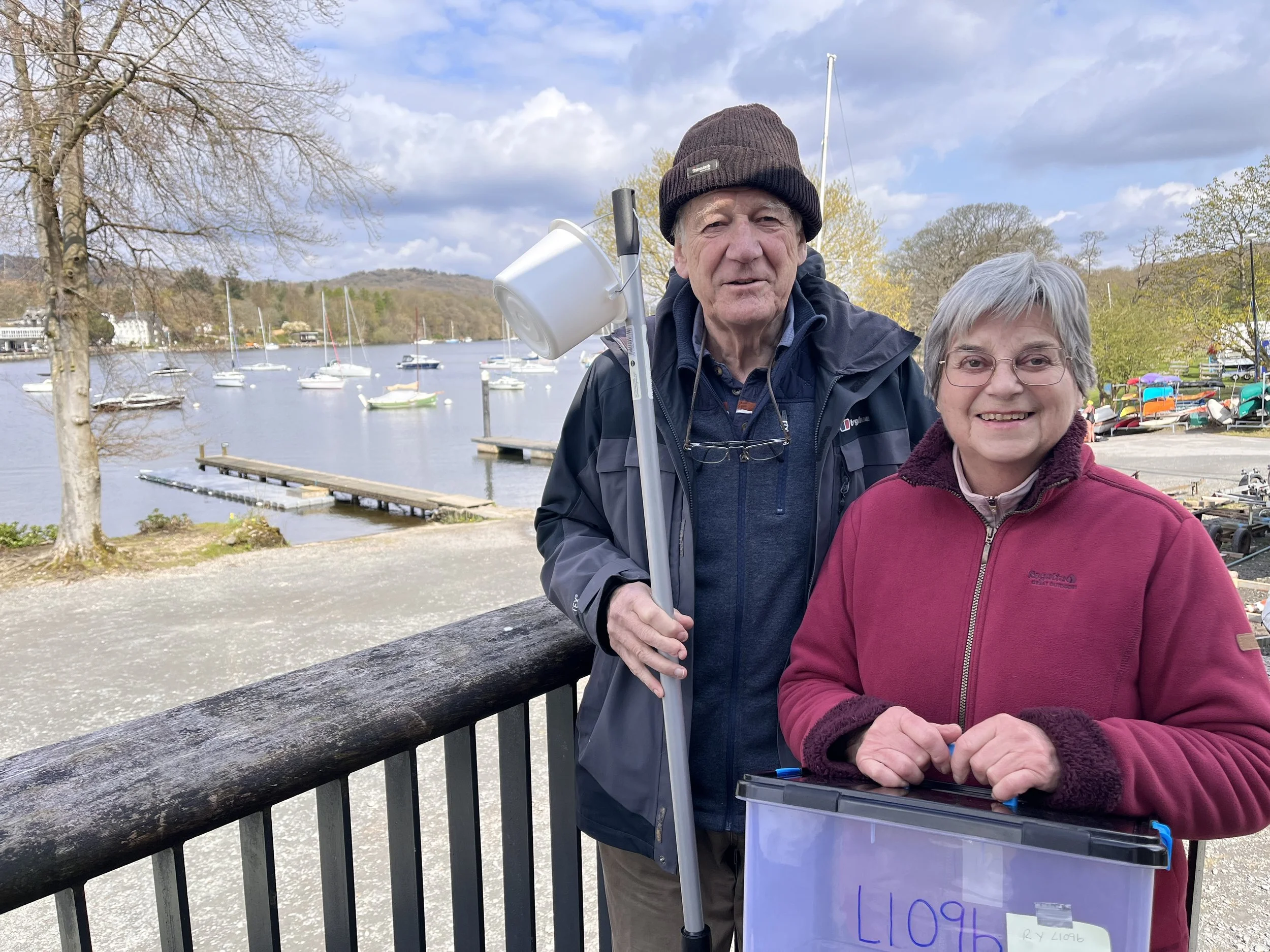
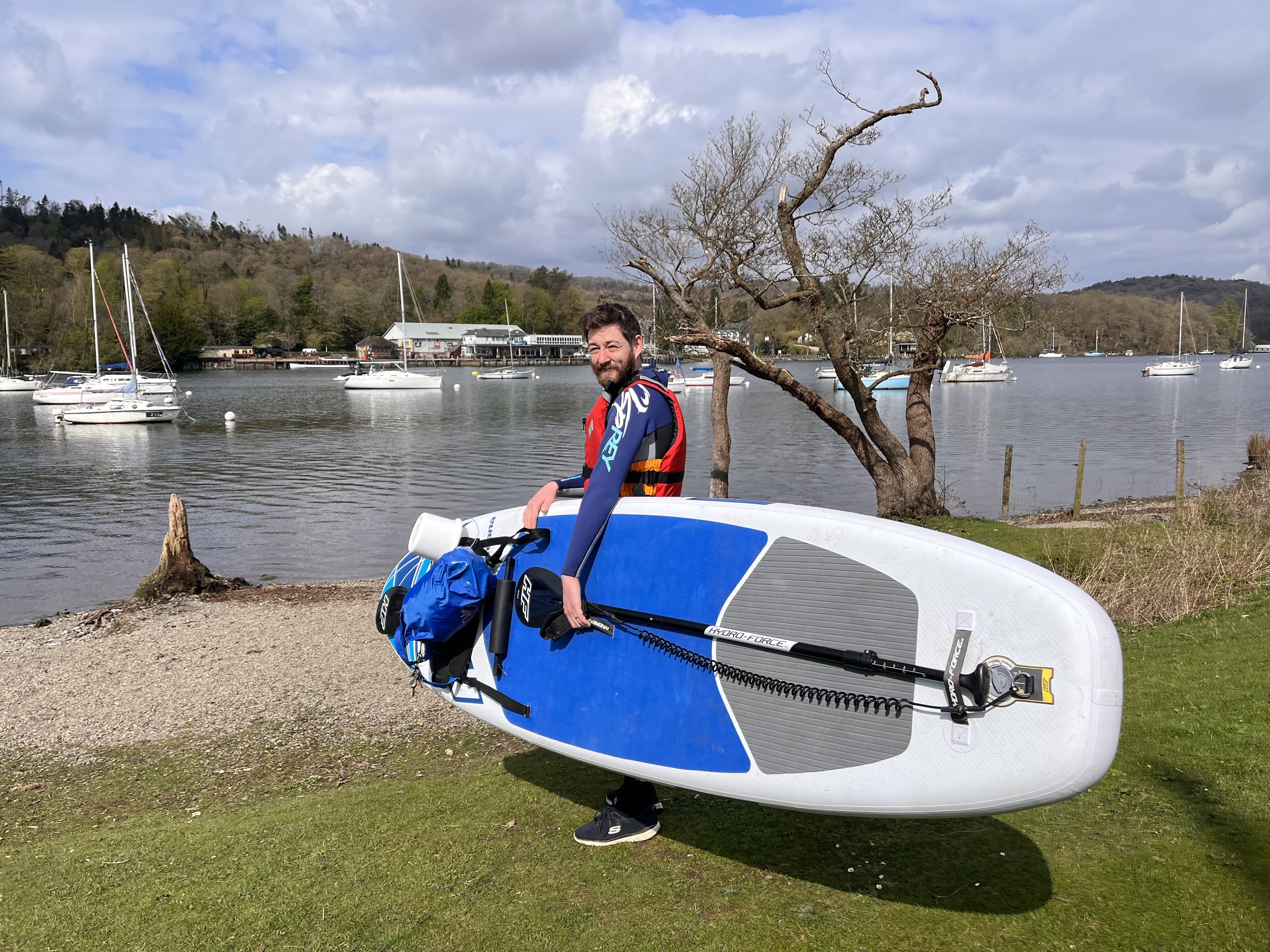
On Sunday 23rd April 2023, the fourth Big Windermere Survey took place in the spring season, rounding off one full year of the Big Windermere Survey. Water samples were collected by volunteers from 98 sites throughout the Leven catchment, including from Grasmere, Rydal Water, Blelham Tarn, Esthwaite Water, Ghyll Head reservoir, Windermere and a number of key inflow streams for Windermere. All samples were taken between approximately 10am and 2pm on the day with local weather conditions generally dry and bright.
Samples have been analysed for a range of water quality parameters within research laboratories at Lancaster University and bacterial analysis was completed at externally accredited laboratories following standard protocols. To find out more about the parameters that are analysed, please read our Water Quality Guide. The full data set is now available to view on a map via Cartographer. Our Summary Report explains the results in more detail.
We have presented the water quality results in the context of EU Water Framework classifications and the bacteria data in the context of the EU Bathing Waters Directive classifications. However, classification of water quality against standards requires long term datasets, comprised of multiple samples taken from each location to capture variation in water quality, such as between seasons. Water quality standards are used to provide context for the results. As future surveys generate additional data, we will be able to undertake more accurate classification of water bodies in the Leven catchment against water quality standards.
Click to read our Summary Report, or see the full dataset on Cartographer.
For any queries, please contact: windermere@fba.org.uk or have a look at out our FAQs.
Further reading
The Freshwater Biological Association publishes a wide range of books and offers a number of courses throughout the year. Check out our shop here.
New Course!
Assessment of Freshwater Algae Incidents
We are excited to announce this new 2 day course which is designed to equip staff of environmental and other agencies, water companies and consultancies in the monitoring and assessment of algal ‘incidents’ in freshwaters.
The course is designed to be an introduction for those with limited experience of freshwater algae. Areas covered during the course include appropriate methods for sampling, storage and preparation of samples and microscope analysis.
The basics of identification of major groups of algae found in freshwaters will be covered along with the pros and cons of different counting methods for algal incidents
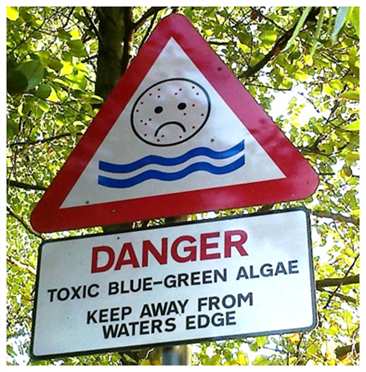
Special attention will be given to the identification of nuisance algae including cyanobacteria (blue-green algae), green algae and diatoms. Other nuisance algae will be covered briefly.
All stages will be illustrated by practical demonstrations and exercises.
Finally, a broad understanding of assessment of results and appropriate responses to incidents and reporting will be presented.
Participants on all FBA courses must be 18 years and above.
Dates: 23th – 24th June 2026
Location: Nottingham University
Tutors: Professor Martyn Kelly, Dr Bill Brierley and Sarah Pritchard
Price: £650 for non-members or £585 for FBA members
Please select ‘pick-up’ after placing your order to ensure you are not charged postage on your booking.
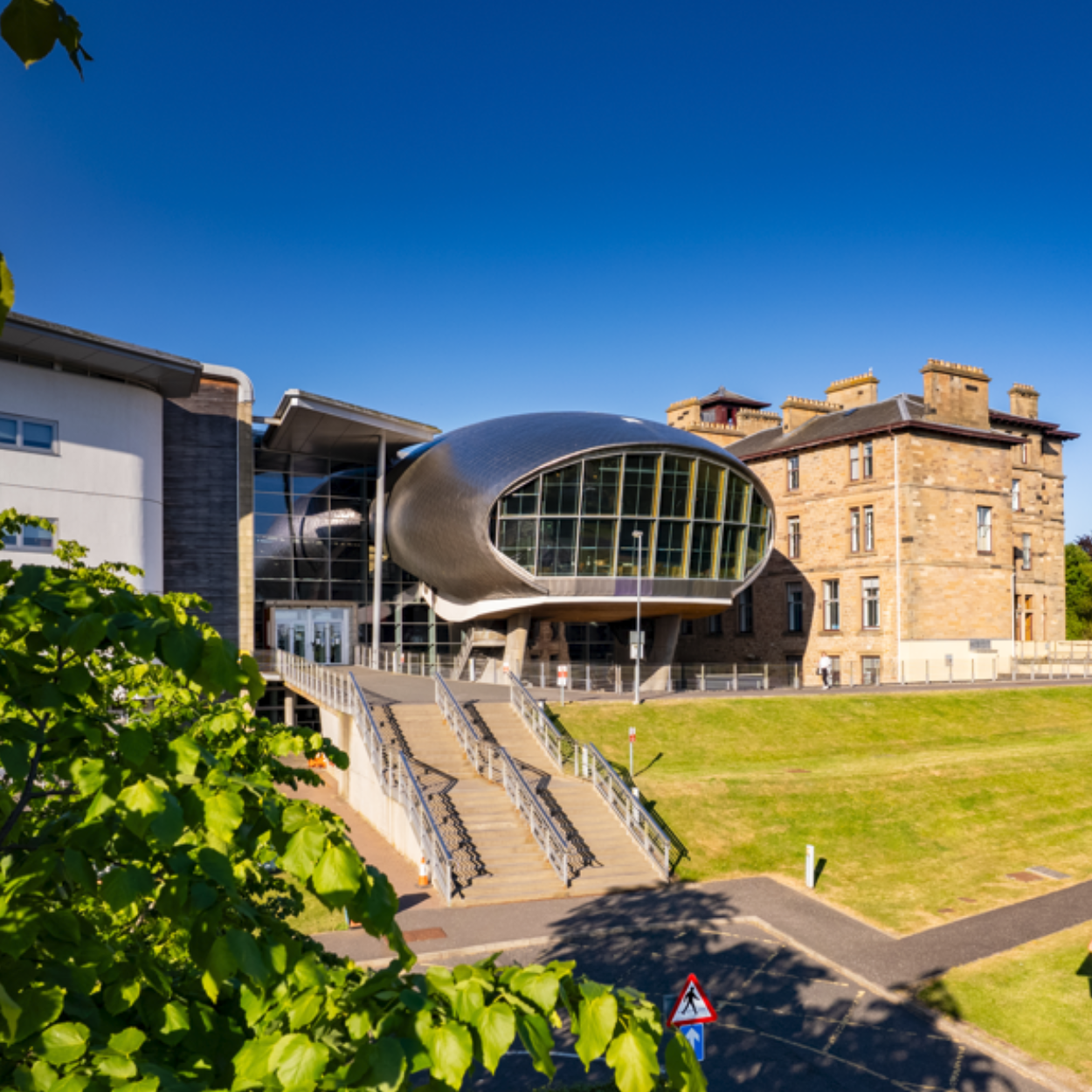
The FBA Annual Scientific Meeting 2026 is an in-person only event on Thursday, 11 June at Edinburgh Napier University.
This year’s theme will cover a range of new approaches being used for freshwater science, including bio/hydro acoustics, eDNA, citizen science, drones and the emerging role of machine learning for pattern recognition.
This conference-style event will include keynotes from Jennifer Dodd (Edinburgh Napier University), Bernd Hänfling (UHI Inverness), Jess Lister (PhD student, Edinburgh Napier University) and Brian Hayden (Atomic Ecology).
The event promises additional unmissable treats such as Dr Craig Macadam, Conservation Director at Buglife, presenting on ‘Recognising Riverflies – applying AI to freshwater invertebrate identification’.
On Wednesday 10 June (early afternoon), the day before the ASM, we have also arranged a ‘Water of Leith’ social meet-up for us to have a very informal networking opportunity.
Find out more about the ASM 2026, including the amazing line-up of speakers!
The ASM is priced to cover the costs of the meeting and includes hot and cold drinks and snacks during the reception and afternoon break, and a buffet lunch.
FBA members rate £65
FBA student / early career member rate £32.50
Non-member rate £120
Non-member (student) rate £55
Become a Member of the FBA today and benefit from discounted registration to the ASM 2026.
We look forward to welcoming you at the FBA Annual Scientific Meeting on Thursday 11 June 2026 in Edinburgh!
And see you at the Water of Leith meet-up too, if you can make it.

NOW HALF PRICE!
The Riverfly Partnership 2026 Calendar is available to order today!
Celebrate the beauty of riverflies all year round with the Riverfly Partnership 2026 Calendar. Featuring stunning images from our photography competition, each month showcases the vibrant species and habitats our volunteers work to protect. Every purchase supports our citizen science programme and helps safeguard the health of our rivers for future generations.
The Riverfly Partnership is a dynamic network of organisations working together to:
protect the water quality of our rivers;
further the understanding of riverfly populations;
and actively conserve riverfly habitats.
Riverflies are invertebrates that spend most of their life cycle in a river, stream or pond. This calendar features the three key groups of riverflies: stoneflies, caddisflies and mayflies.
Huge thanks to all entrants for submitting so many wonderful photos!
The calendar is A4 landscape, filled with fabulous photography to inspire you with riverflies throughout 2026!
Thank you to our funders: the Environment Agency & Esmée Fairbairn Foundation.

This River Restoration Modelling Course covers the upland river settings. The lowland river settings course may be booked separately.
With the advent of improved computing power, user-friendly software and easier acquisition of base data, the tasks required to deliver river naturalisation have become easier. In particular, the ability to rapidly simulate the action of water across the riverine landscape has revolutionised our ability to understand fluvial processes and to harness this knowledge to rejuvenate degraded systems in a targeted manner.
This course introduces simple 2D modelling through a set of hands-on exercises to develop flow simulations across a varied fluvial landscape. It is targeted at those interested in this area but with no prior knowledge of river modelling. Anyone interested in NFM, river and floodplain restoration and tributary and drainage improvement will benefit from the course. Delegates will, under supervision, build their own models (no laptop required) and assess outputs using the results to suggest local interventions that improve hydromorphological functioning. All software and base data are free and these, together with the results from the day, can be downloaded and retained by delegates at the end of the course.
Key course components:
The history and value of modelling
Different types of models and their uses (catchment, NFM, river design, ecohydraulics etc.)
Mapping flow in the catchment using GIS & rainfall models
Simple reach-scale modelling to map opportunities and constraints
Example modelling exercise
Utilising the results for system naturalisation
Date: To be confirmed soon
Note: This is a one day course and will explore an upland river setting. Lunch will be provided.
Location: Field Studies Council Laboratory, Castlehead, Grange-Over-Sands, Cumbria, LA11 6QT
Tutor: George Heritage & Kieran Sheehan
Price: £260 for non-members and £234 for FBA members
Please click on the following link to download and complete the booking form then email to info@fba.org.uk: FBA Courses Booking Form.docx
TO AVOID POSTAL CHARGES PLEASE SELECT ‘PICK UP’ OPTION AT CHECKOUT.
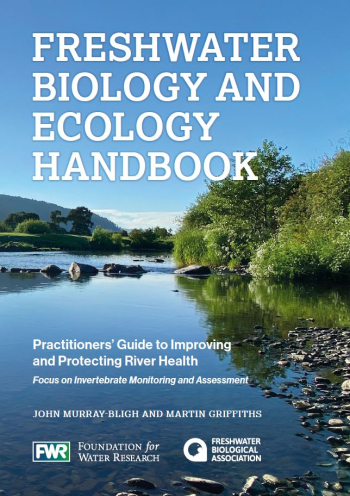
This handbook provides an overview of the biological and ecological methods used to assess the status of the freshwater environment, with a focus on invertebrate methods. Good river health is the key outcome and aim of this work. The handbook describes how biological methods are used in the UK to improve and protect freshwater quality by delivering the Water Framework Directive. The principles underlying that delivery are constants and feed forward into possible reshaped UK approaches in the future.
The book is aimed at students, operational ecologists (including citizen scientists), nascent environment protection agencies (including those joining the European Union), and policy makers in the UK.
· Chapter 1 provides an overview, including the legal framework for freshwater biological monitoring
· Chapter 2 is a practitioner’s guide to the standard methods for invertebrate sampling and data collection
· Chapter 3 provides an understanding of current river invertebrate classification methodologies, focussing on RIVPACS and surveillance & operational monitoring.
· Chapter 4 looks at other sampling methods for investigative monitoring
· Chapter 5 looks at indices and data analyses for investigations, including the increasing contribution from citizen science programmes.
· Chapter 6 considers the reporting methods used in the UK and the EU, specifically with links to investment programmes, driven by the monitoring and assessment information. It also provides links to publicly available datasets.
The focus is on river invertebrate methodologies and on status classification, using the UK’s RIVPACS approach to provide a working example of what is needed to set up a biological monitoring programme for a national initiative, a river catchment or a specific tributary. Public participation through citizen science initiatives and are increasingly important for gathering data and presenting evidence, and those methods are also described. Most invertebrate methods use similar key principles, and we expect users to modify and adapt methods to their specific situations as needed.
Several important biological and ecological methods are not covered in this handbook, including fish, macrophyte, diatom, DNA, and river habitat assessments, river restoration methodologies, still-water methods, and statistic and computing methods. We would like other specialists to work in collaboration with FWR and FBA to add additional chapters or sections to expand its coverage.
The core elements described here are the basis for training programmes and university teaching, to provide the expertise to consolidate the improvement of river health into the future. We also hope that they provide a useful insight for civil servants, water managers, specialists, and river conservation groups working to improve and protect our invaluable freshwater environment.
In making this publication free of charge and for public good, we hope to accelerate the development and use of biological monitoring and assessments to improve the understanding of freshwater systems around the world.
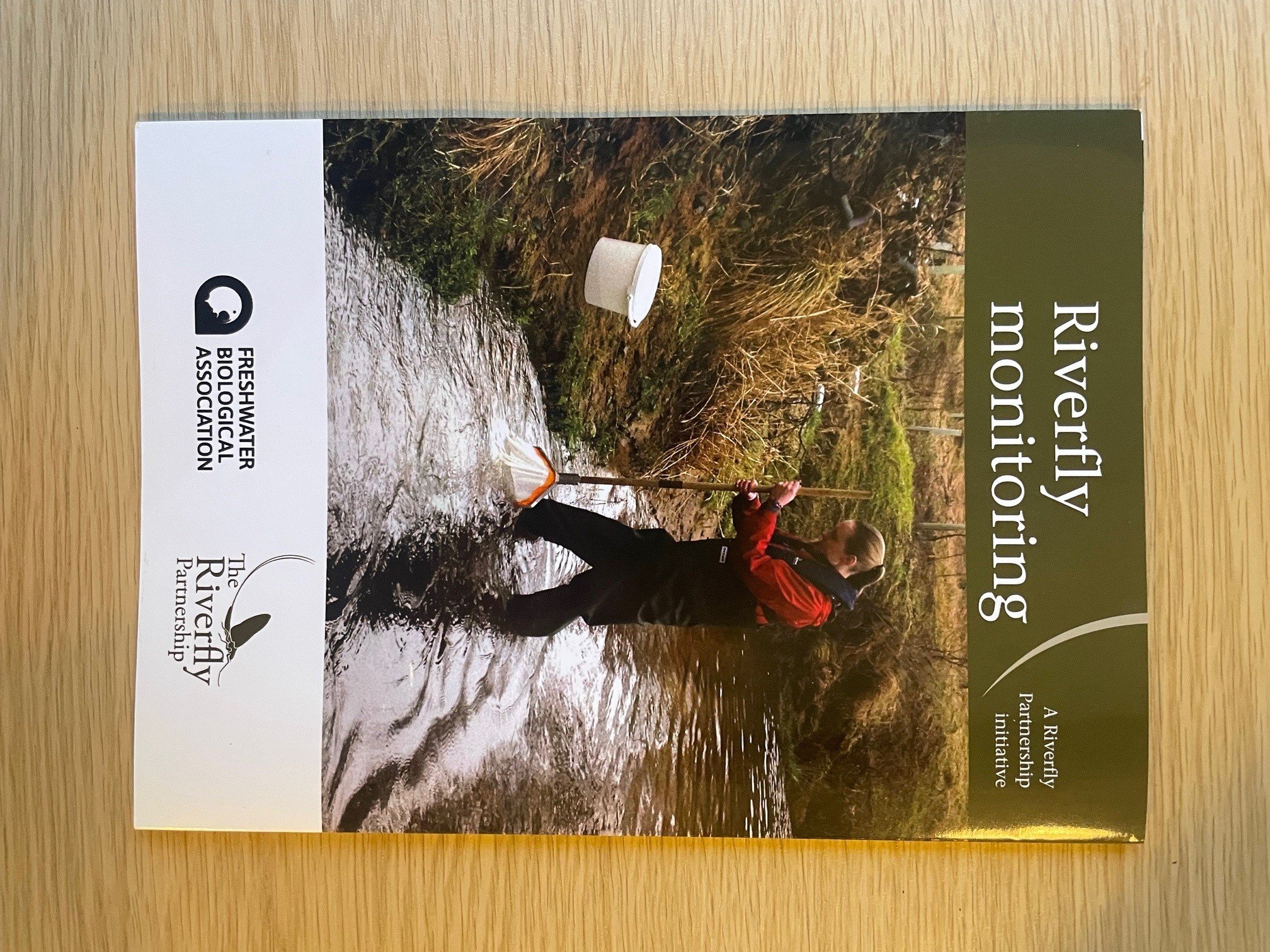
Only to be purchased by Riverfly monitors who have completed their Riverfly training and are in need of a replacement.
At your training day, you will have received this fold-out Riverfly monitoring guide, with ID information on the RMI Eight, and background information on the Riverfly Monitoring Initiative. If yours has got lost or damaged, you can purchase a new one here. Please only purchase these guides for personal use — they are for use by trained monitors only. A guide is not a sufficient substitute for an entire training pack — if you are looking for the full training pack for running a Riverfly training day, please e-mail us at info@riverflies.org for details.
Only to be purchased by Riverfly monitors who have completed their Riverfly training and are in need of a replacement.

Be transported to the fascinating and beautiful world of microscopic freshwater algae. A rare opportunity to purchase a comprehensive and mesmerising photographic display of algal organisms. This hardback 360 page book by Hilda Canter-Lund & John WG Lund, Honorary Research Fellows of the Freshwater Biological Association, was first published in 1995. Containing over 600 colour and monocrome photographs with commentaries, the book provides technical, but understandable, scientific detail. Enjoy a delightful journey through the microscope into freshwater algal groups.

This new guide, which is derivative of T.T Macan’s ‘A Key to the Adults of British Trichoptera has been written with the intent to introduce those with a strong interest, but little experience in the identification of caddisflies. Perfect for those who wish to become familiarised with different caddisfly families prior to ventures in the identification of species level keys, this book is a fitting accompaniment for caddisfly fieldwork. Included is this succinct book is a checklist of the caddisfly species within Britain and Ireland for a complete look at the possible species that may be found.
Author: Stuart Crofts
Published By: FBA/FSC, 2019
Format: Soft Cover. 98 Pages
ISBN: 978 0 900386 83 1
This digital version of the Freshwater Biology and Ecology Handbook is free to download, but we would be extremely grateful if you would be happy to make a £5 donation for the e-book.
As a registered charity we rely on the generosity of our donors and our membership base in order to carry out work necessary to ensure a healthy future for our river and lake habitats. If you choose to support us, your donation will be making a difference for our freshwaters and all who use them.
If you're happy to make a £5 donation for this download (thank you!), please visit this £5 donation / download page.
This handbook provides an overview of the biological and ecological methods used to assess the status of the freshwater environment, with a focus on invertebrate methods. Good river health is the key outcome and aim of this work. The handbook describes how biological methods are used in the UK to improve and protect freshwater quality by delivering the Water Framework Directive. The principles underlying that delivery are constants and feed forward into possible reshaped UK approaches in the future.
The book is aimed at students, operational ecologists (including citizen scientists), nascent environment protection agencies (including those joining the European Union), and policy makers in the UK.
· Chapter 1 provides an overview, including the legal framework for freshwater biological monitoring
· Chapter 2 is a practitioner’s guide to the standard methods for invertebrate sampling and data collection
· Chapter 3 provides an understanding of current river invertebrate classification methodologies, focussing on RIVPACS and surveillance & operational monitoring.
· Chapter 4 looks at other sampling methods for investigative monitoring
· Chapter 5 looks at indices and data analyses for investigations, including the increasing contribution from citizen science programmes.
· Chapter 6 considers the reporting methods used in the UK and the EU, specifically with links to investment programmes, driven by the monitoring and assessment information. It also provides links to publicly available datasets.
The focus is on river invertebrate methodologies and on status classification, using the UK’s RIVPACS approach to provide a working example of what is needed to set up a biological monitoring programme for a national initiative, a river catchment or a specific tributary. Public participation through citizen science initiatives and are increasingly important for gathering data and presenting evidence, and those methods are also described. Most invertebrate methods use similar key principles, and we expect users to modify and adapt methods to their specific situations as needed.
Several important biological and ecological methods are not covered in this handbook, including fish, macrophyte, diatom, DNA, and river habitat assessments, river restoration methodologies, still-water methods, and statistic and computing methods. We would like other specialists to work in collaboration with FWR and FBA to add additional chapters or sections to expand its coverage.
The core elements described here are the basis for training programmes and university teaching, to provide the expertise to consolidate the improvement of river health into the future. We also hope that they provide a useful insight for civil servants, water managers, specialists, and river conservation groups working to improve and protect our invaluable freshwater environment.
In making this publication free of charge and for public good, we hope to accelerate the development and use of biological monitoring and assessments to improve the understanding of freshwater systems around the world.
Get involved
Our scientific research builds a community of action, bringing people and organisations together to deliver the urgent action needed to protect freshwaters. Join us in protecting freshwater environments now and for the future.

NEW COURSE: Pond Restoration Training: North West England on 6 & 7 July 2026. From £250.00
Ponds are increasingly recognised as critical features for biodiversity conservation across UK landscapes. This two-day course will introduce participants to the science and best practice of pond restoration.
Helen Greaves of the Pond Restoration Research Group at University College London (UCL) is a co-founder of the Norfolk Ponds Project (NPP) and Executive Director of the NPP Community Interest Company (CIC). With over 15 years’ experience restoring ponds and researching their ecological recovery, and following publication of the recent Guide to the Restoration, Creation and Management of Ponds, Helen is keen to share key lessons and practical insights from both the UCL and NPP teams.
The course will include a combination of lectures, workshops, and field visits focused on the restoration of degraded overgrown ponds and in-filled “ghost ponds”.
Participants will be introduced to the scientific evidence underpinning pond restoration, including the benefits for freshwater and terrestrial biodiversity. The course will also cover the key DOs and DON’Ts of restoration, including pond selection and important considerations during the restoration process.
Field visits will explore two contrasting pond landscapes typical of West Lancashire. One site is situated within a lowland floodplain landscape, while the other lies within a higher arable setting adjacent to a nature reserve. These visits will provide an opportunity to compare ponds across different land uses, including farmland and conservation-focused landscapes. Participants will consider how landscape context influences restoration potential, management approaches, and ecological outcomes, including the specific challenges and opportunities associated with restoring existing ponds and resurrecting ghost ponds.
The course will also address approaches to engaging landowners, farmers, and local communities in pond conservation, alongside practical routes for securing funding to support restoration work.
Participants on all FBA courses must be 18 years and above.
Location: West Lancashire (near Ormskirk)
Tutor: Helen Greaves
Price: £275 for non-members, £250 for members
Please click on the following link to download and complete the booking form then email to info@fba.org.uk: FBA Courses Booking Form.docx
TO AVOID POSTAL CHARGES PLEASE SELECT ‘PICK UP’ OPTION AT CHECKOUT.
Please note: Payment must be made in full via the website in order to secure your place on this course.