Clean Water Campaign founder fundraising for FBA
15 August, 2023
Clean Water Campaign founder, Harrison Hunter, is to attempt to swim the length of Windermere on Saturday 19 August in order to raise awareness about water quality and money for charity.
Harrison Hunter, an elite athlete and sports physiologist from Truro, Cornwall, is a relative newcomer to wild swimming, having only taken up the hobby a few months ago.
With an interest in climate and environmental action, Harrison says, “I’ve witnessed first-hand the worrying levels of sewage pollution, the dangerously high levels of blue-green algae in our lakes and the lack of biodiversity in our rivers. And that’s just me in my first few months entering the world of wild swimming.”
Keen to do something about it, Harrison launched the Clean Water Campaign, which aims to raise awareness as well as money for charity. Harrison commented, “I am targeting, along my journey as a swimmer, to raise awareness on the key issues, educate where I can and support the amazing work currently going on in the background to save our waters. I want to help the countless charities and organisations working tirelessly for us, for our water.”
Among Harrison’s chosen charities is the Freshwater Biological Association (FBA), which was established in 1929 and still has its offices on the shores of Windermere. The FBA is a Non-Governmental Organisation and charitable trust dedicated to understanding and conserving freshwaters across the globe.
Harrison says, “I set out the Clean Water Campaign to understand what problems we’re facing, how I can help raise awareness to these problems and where I can start to make changes to fix them. Over the past 6 – 10 months I’ve been researching, learning, and coming up with a strategy for ways I can help. This is where the Freshwater Biological Association come into it.
There’s a lot of work going on behind the scenes that I didn’t know about and the Freshwater Biological Association stood out to me immediately. Based near Newby Bridge, Cumbria, the work the FBA are undertaking is vast, but also highly focused on the local environment, most notably Windermere.
I don’t have the knowledge or expertise to fix important issues alone, but by supporting the FBA, the attention to detail they go into on their citizen science projects was a way I could start to make a difference.
I’m incredibly inspired by their commitment, and the individuals that work under the radar to make all this possible. During tough moments of the swim and throughout training, I always carry in the back of mind why I’m doing this and why it’s incredibly important we continue to support organisations like the FBA.”
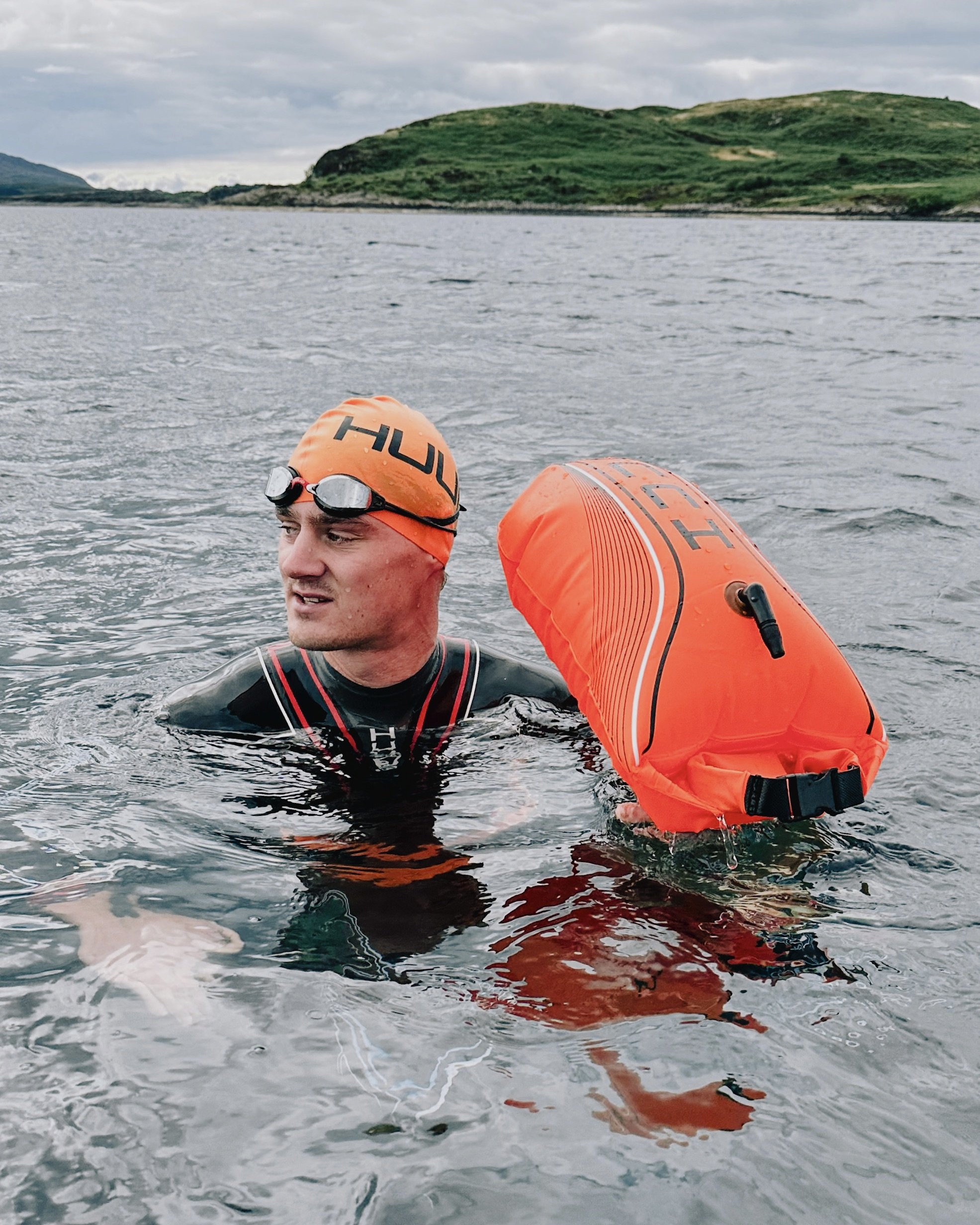
Harrison Hunter, preparing to swim the length of Windermere
Of course, the FBA are extremely thankful to Harrison to be fundraising, undertaking a challenge that is certainly not for the faint-hearted! Windermere is England’s largest lake, being approximately 11 miles long.
Windermere Senior Scientist at the FBA, Lynsey Harper, commented “We are extremely grateful to Harrison for supporting our work. Windermere is an exemplar lake showing how multiple pressures come together to affect biodiversity and water quality. These pressures include nutrient and faecal material inputs, climate change, land use change, tourism and recreational activities. Long-term data on the lake’s biology and water chemistry are key to provide evidence-based solutions to these issues. Our Big Windermere Survey with Lancaster University is an unrivalled spatial data set describing water quality in Windermere and the Leven catchment in which it sits. Citizen scientists are trained to collect water samples from approximately 100 different locations on Windermere and in the rivers and lakes that flow into it. The samples are analysed at independent laboratories for nutrient and bacterial concentrations that indicate the potential for algal blooms and faecal pollution respectively, producing the largest, one-day snapshot of conditions in Windermere. Hotspots of poorer water quality have now been identified, supporting action to address these.”
The idea for the challenge began as a drunken idea between Harrison and his friend, Dave Barstow, an accomplished swimmer from Cumbria, who will be accompanying him on the swim. However, the proposal to undertake a one-way swim of Windermere soon gained traction and the pair have been increasing their training, spending more time swimming in seas, rivers and lakes.
Taking place on 19 August 2023, setting off from Fell Foot at 6.55am, the swim is expected to take around eight hours, arriving at Brathay Hall at 2.00pm.
Harrison hopes to raise £3,000, which will be split equally across his chosen charities. If you would like to support Harrison and his Clean Water Campaign, you can donate directly on his Crowdfunder page here.
Further reading
The Freshwater Biological Association publishes a wide range of books and offers a number of courses throughout the year. Check out our shop here.


Get involved
Our scientific research builds a community of action, bringing people and organisations together to deliver the urgent action needed to protect freshwaters. Join us in protecting freshwater environments now and for the future.

NEW COURSE: Pond Restoration Training: North West England on 6 & 7 July 2026. From £250.00
Ponds are increasingly recognised as critical features for biodiversity conservation across UK landscapes. This two-day course will introduce participants to the science and best practice of pond restoration.
Helen Greaves of the Pond Restoration Research Group at University College London (UCL) is a co-founder of the Norfolk Ponds Project (NPP) and Executive Director of the NPP Community Interest Company (CIC). With over 15 years’ experience restoring ponds and researching their ecological recovery, and following publication of the recent Guide to the Restoration, Creation and Management of Ponds, Helen is keen to share key lessons and practical insights from both the UCL and NPP teams.
The course will include a combination of lectures, workshops, and field visits focused on the restoration of degraded overgrown ponds and in-filled “ghost ponds”.
Participants will be introduced to the scientific evidence underpinning pond restoration, including the benefits for freshwater and terrestrial biodiversity. The course will also cover the key DOs and DON’Ts of restoration, including pond selection and important considerations during the restoration process.
Field visits will explore two contrasting pond landscapes typical of West Lancashire. One site is situated within a lowland floodplain landscape, while the other lies within a higher arable setting adjacent to a nature reserve. These visits will provide an opportunity to compare ponds across different land uses, including farmland and conservation-focused landscapes. Participants will consider how landscape context influences restoration potential, management approaches, and ecological outcomes, including the specific challenges and opportunities associated with restoring existing ponds and resurrecting ghost ponds.
The course will also address approaches to engaging landowners, farmers, and local communities in pond conservation, alongside practical routes for securing funding to support restoration work.
Participants on all FBA courses must be 18 years and above.
Location: West Lancashire (near Ormskirk)
Tutor: Helen Greaves
Price: £275 for non-members, £250 for members
Please click on the following link to download and complete the booking form then email to info@fba.org.uk: FBA Courses Booking Form.docx
TO AVOID POSTAL CHARGES PLEASE SELECT ‘PICK UP’ OPTION AT CHECKOUT.
Please note: Payment must be made in full via the website in order to secure your place on this course.