Riverkin: remaking vital relations with rivers
29 September, 2025
We had the great pleasure of Professor Julia Martin-Ortega presenting the final Keynote at the FBA Annual Scientific Meeting in June. Rounding off a day of inspiring freshwater talks, with an intensely poignant and memorable deep dive into Riverkin, an approach hoping to help people remake vital relationships with rivers and freshwaters.
So, with our interest in Riverkin well and truly whetted, we caught up with Julia Martin-Ortega and Dr Josh Cohen from water@leeds, at the University of Leeds, for a Q&A to find out more about Riverkin.
To start, please could you give us a little bit of background into your research in freshwater science and water management...
Josh:
My background is in environmental and social anthropology. Anthropology is an extremely broad discipline, but my own take tends to align quite well with Tim Ingold’s description of anthropology as ‘philosophy with the people in’. I am fascinated by the kinds of questions that philosophers ask, questions about how we know the world, and how we together might live a ‘good’ life. As opposed to the perhaps more abstracted ways philosophers might work, I try to approach these questions through engagement with the messy realities of people’s lives.
Freshwater has of course always been fundamental to human life and my current work thinks about connections between how we treat water as a society and what we understand water to be.
Julia:
My research aims to further the understanding of the relationships of communities and individuals with ecosystems and how policy can best make use of this understanding for a more sustainable management of water and land. As an ecological economist, I take a critical view of mainstream ways of conceptualising our relationship with nature and look for new ways of incorporating the plural values that humans hold for nature in policy and management decisions.
Freshwater ecosystems have always been at the core of my research, from early work on the implementation of the Water Framework Directive, to my current work on the restoration of wetlands.
Could you tell us more about the water@leeds Riverkin project?
This has research and engagement sides to it.
Research
We have published one paper (in People and Nature) and a chapter on this concept (see links below) and are working on others. In the People and Nature article, we coined the term ‘Riverkin’. In essence, the argument in that paper starts from the recognition that outside of colonial modernity, freshwater, along with what is commonly referred to as ‘nature’ in general, has often been understood to be part of a kinship network that is not limited to the human. Such networks, ideally based on reciprocal relations of care and responsibility, are what constitute both humans and more-than-humans as socio-physical beings, as persons. They have been foundational to social forms which have been compatible in the long-term with a thriving, living world.
Through the historical, economic, social, philosophical, and technological processes that have constituted colonial modernity, water has however in many parts of the world come to be understood as an object, a ‘thing’, a potential and actual commodity. This transactional and exploitative relationship is an important reason why freshwater is globally in the state we find it today. As such, reigniting reciprocal relations of care and responsibility with freshwater will likewise, we argue, be a vital part of any long-term solution.
Engagement
We have been astounded by the response we nearly always receive to the concept of Riverkin. When we have presented in public fora, people just seem to get it. We really are humbled and honoured by the various ways in which people have wanted to collaborate and connect with us on it – including of course the Freshwater Biology Association. In the primarily conceptual People and Nature article, we suggest that existing literature makes a good case for Riverkinship being a nascent possibility in the UK. We wanted a chance to test the thesis in the real world and in collaboration with the Nidd Action Group (NAG) have recently had a chance to do this*.
The Nidd is a river in North Yorkshire that runs south and eastwards from the Yorkshire Dales down towards the Ouse River, through a number of small towns, including Knaresborough. Nidd Action Group work for the health of the river and are a wonderful, supportive group of people. Just to say! Anyway, in Knaresborough, we held a discussion evening, a floating seminar, a public engagement day by the riverbank, an exhibition in the local library, and a series of interviews with event participants. This has led to many more connections, including to the growing Rights of Nature movement. We are always looking for fresh opportunities to meet people and collaborate.
Riverkin floating seminar event in Knaresborough on 2 May 2025 - photo credit Lens Lab Project.


Riverkin exhibition in Knaresborough library in May 2025.
And what does 'Riverkin' mean exactly?
Excellent question. Summarising from our response above, this means something like ‘Relating to freshwaters as you might friends or family’. However, we don’t see this as something fixed and settled, and what Riverkin or Riverkinship means precisely would need to be worked out as collectively and inclusively as possible, hence its dynamic and unsettled nature. We are focused on the UK since we are based here, but see it as a globally relevant argument – and we have indeed tried to learn from Indigenous experience and knowledge from various parts of the world.
Riverkin |ˈrɪvəkɪn |
‘Relating to freshwaters as you might friends or family’
This is not a romanticised vision of family, the past, or of other cultures, but a recognition that there are foundational, deeply embedded reasons why the planet is in the state it currently is. It is a simple acceptance that there is a lot to be urgently learnt from humanity’s heritage that lies outside of current social-political-economic forms and associated ways of understanding the world.
‘Riverkin’ is the snappy, relatable, term which can help to draw attention to all this but is itself of course not the point! Our aim is to put the term out there and for people to use it and give it meaning – re-igniting relationships of kinship with rivers.
How do you think a Riverkin approach could help support freshwater ecosystems and water management?
In many ways, across multiple scales which would need to work together to be successful.
One scale would be the personal. If people recognise kinship with freshwaters, they will be motivated to protect them from harm, to care for them, with a motivation as passionate as would be associated with protecting and caring for family and friends. You don’t want your riverkin to be polluted so you try to avoid pouring pollutants into them. And you want others to do the same, including those with the power to decide what companies and other large organisations do. This would need to work hand-in-hand with programs for all people, from kids to pensioners, to learn more about and to be practically introduced to, their waters and associated human and more-than-human communities. This is not to suggest that the solution lies in the sovereign individual, this figment itself largely being a product of colonial modernity’s tendency to thingify through shearing off the relations through which we become persons.
We probably need to rediscover and or invent collective activities, rituals and ceremonies that in meaningful ways reconnect us with and celebrate freshwater. Already, many people feel very strongly motivated to protect and care for our waters in these ways – but it needs to be more generalized so that such responsibility does not fall on the shoulders of a relatively small number of, for example, retired people. Such programs and movements would also need to actively address class and wealth-related discrepancies of knowledge of, access to, and time with freshwaters.
“If people recognise kinship with freshwaters, they will be motivated to protect them from harm, to care for them, with a motivation as passionate as would be associated with protecting and caring for family and friends. You don’t want your riverkin to be polluted so you try to avoid pouring pollutants into them. And you want others to do the same, including those with the power to decide what companies and other large organisations do.”
At this point, the political nature of this starts to come more clearly into view, and we need to work carefully and strongly on the institutional, governance and legal side of things. We know the critiques of Rights of Nature, and these have validity, especially questions about who is going to enforce newer, better laws. However, we do need different ways for governance structures to be able to ‘see’ our freshwaters as more than things, or just ‘natural resources’, if we want to imagine a fundamentally different, thriving future. A thriving future where an expanded human and more-than-human community has a meaningful ability to be part of deciding what that future looks like.
There is a lot of discussion at the moment about whether we can ‘afford’ to manage our waters in fundamentally different ways. Some argue we can do this within capitalism, but perhaps in fact we cannot within a capitalism staggering under the weight of multiple, seemingly irresolvable crises. If the latter is the case, we need to decide whether we are prepared to sacrifice our kin to keep the money flowing, or, if collectively, we are going to go back to the drawing board.
Riverkin Stories – public engagement day by the River Nidd in Knaresborough on 20 May 2025 - photo credit Lens Lab Project.
River Nidd Memories and Ancestors painting by James McKay
James McKay's painting ‘River Nidd Memories and Ancestors’ was produced live at the Riverkin public engagement event on 20 May in Knaresborough. The picture shows the whole river Nidd through space (a map) and time. James McKay was inspired by the talk from Hayden Turoa, from the Māori community of the River Whanganui in New Zealand, given at the Riverkin project event in Knaresborough in May 2025.
“Rivers are permanent (though always changing) whereas we humans pass through the landscape like ghosts. So the picture jumbles together people from all sorts of different time periods along with all the wildlife, including the small invertebrates (river fly) that the river system depends on. Some of the pictures represent legends and folk stories about our ancestors – they may not be real, or accurate. For example, the female pagan priestesses at Brimham Rocks could be ancestors from ancient times, or ‘just’ Victorian ladies dressing up. Some pictures represent my own personal memories and historical imaginings.
All of us: modern people, our children, our ancestors, our stories and legends, animals, plants, rocks, earth and water are bound together by the flow of the river through time and space.”
And what do you feel are the wider community and ecological benefits of a Riverkin approach helping people remake vital relations with rivers?
One critique that friends, colleagues, and members of the public have levelled at the notion of Riverkin is that it takes a rose-tinted view of family. Families, they say, and they are right, can be suffocating, violent, abusive, highly damaging to our bodies and psyches. This is an important point. One partial response to this is that the sicker the society, the more likely are our familial relations to be of these unhealthy types.
Another, related, response is that familial relations can be so damaging because they are so foundational to our being. In one way or another we think pretty much everyone needs core relationships through which they feel safe, loved and cared for, and through which they can love and care in response. If rivers are our kin, then a first step towards cultivating these vital relationships would be to recognize that they are our kin, that there is a relationship of this type there to embrace and nurture. So, again, expanding that kinship network allows the possibility of relationships that nurture us all as social-physical beings. More than that, living in kinship with the living world is mutually rewarding, not least because the community that supports and constitutes you and which you in turn constitute and support, expands exponentially. As our response to the last questioned suggested, this would be inextricably part of improving the ecological state of our freshwaters through improving how we manage and care for them.
“Our latest research is highlighting that it is through shared encounters with, and or stories of, rivers, springs, waterfalls wetlands and so on, that people form and maintain important memories and relationships with each other.”
Additionally, our latest research is highlighting that it is through shared encounters with, and or stories of, rivers, springs, waterfalls wetlands and so on, that people form and maintain important memories and relationships with each other. That might be paddling in a forest pool as a kid, hunting for invertebrates, or scattering a loved one’s ashes.
More of us having more access to and quality time with such places is another way we could nurture human family and community, with freshwater as a kind of conduit. If we build a more fair, caring society, a society that includes our freshwater kin, perhaps there would be less instances of our human and more-than-human familial relationships being violent, abusive etc. And we can all only benefit from that.
Do you have any Riverkin stories or case studies you can share with us?
So many! But here’s one that we often think about.
On May 1st of this year, as part of our NAG project in Knaresborough, we held a discussion evening in a local church hall. We were lucky enough to have three amazing speakers, including Hayden Turoa. Hayden is Māori, part of an iwi, or kinship-based Indigenous nation, that includes the Whanganui River, in Aotearoa New Zealand. Hayden spoke about his elders’ 140 years of struggles that led in 2017 to the landmark, world-famous legal recognition of the Whanganui’s personhood and rights, in the Te Awa Tupea Act.
He pointed out that snappy phrases like ‘Riverkin’ or ‘legal personhood’ and so on are useful ‘clickbait’ for drawing attention to rivers and different ways we might relate to them. More fundamental he argued, is that this was first time that the modern nation of Aotearoa New Zealand had legally recognised Indigenous Kawa (akin to law) which for centuries had understood the Whanganui as an ancestor. What mattered was how this would be taken up in practice and how it might contribute to better long-term relationships with the river.
Hayden went on to speak of some of the Kawas recognized by the 2017 Act, including:
E rere kau mai i te Awa nui mai i te Kahui Maunga ki Tangaroa – The great River flows from the Mountains to the sea
Such Kawa he suggested were “not entirely dissimilar” to the objectives as set out in the Nidd Action Group’s constitution including the aim to:
Make rivers safe for all: Rivers should be safe for everyone - from invertebrates (which are a vital part of the food chain) to fish, birds, animals, and people.
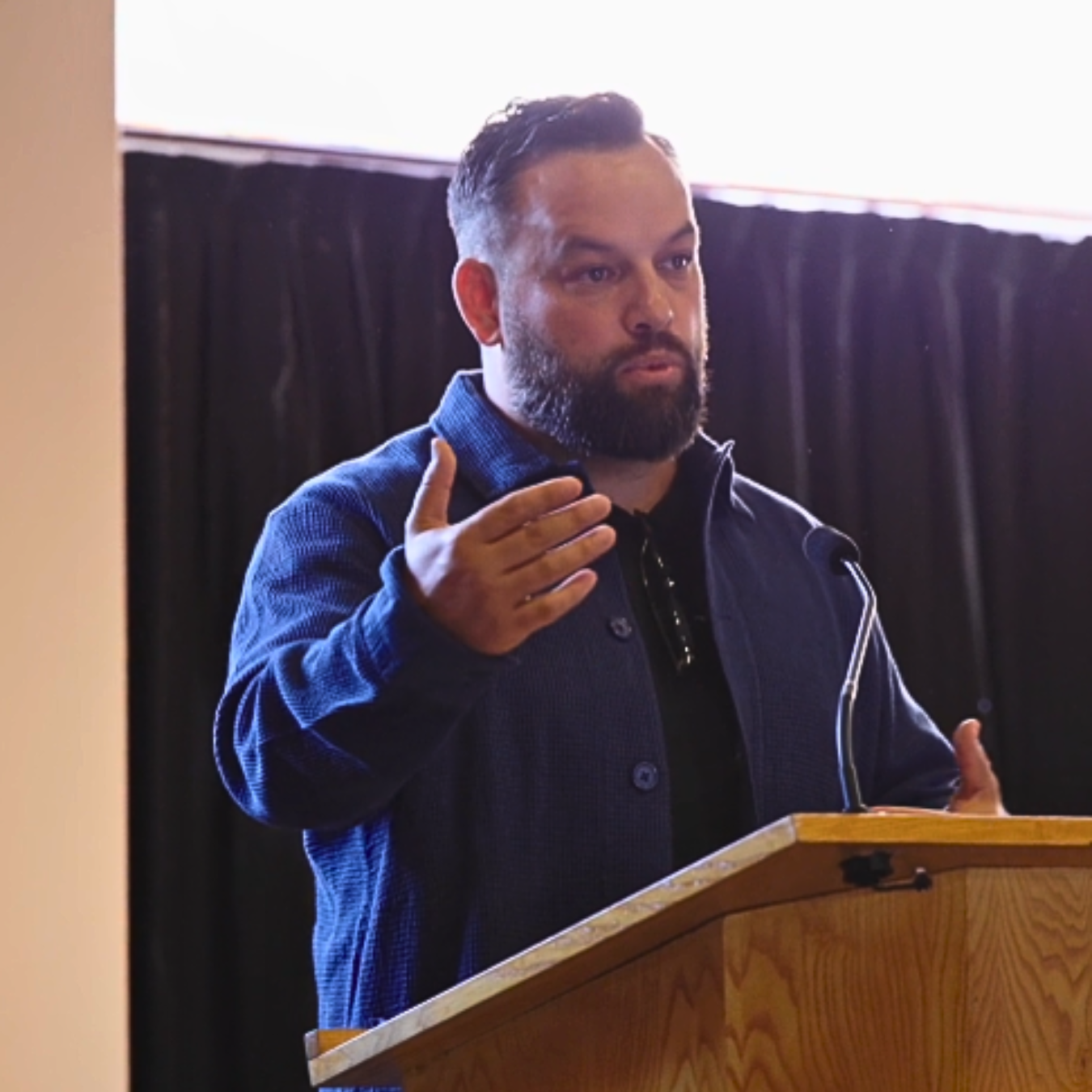
Hayden Turoa, from the Māori community of the River Whanganui in New Zealand, speaking at the Riverkin event in May 2025 - photo credit Dan Waters.
“It may come from a very different ontological background, a very different worldview but deep down that … Kawa is talking about like how [in your constitution] every invertebrate is really important, just like what [we have been talking about today which is the fundamental importance of interconnectedness] … from the mountains to the sea you can’t separate our river [from itself or any of its human and nonhuman communities]”
– Hayden Turoa
“It may come from a very different ontological background”, Hayden went on, “a very different worldview but deep down that … Kawa is talking about like how [in your constitution] every invertebrate is really important, just like what [we have been talking about today which is the fundamental importance of interconnectedness] … from the mountains to the sea you can’t separate our river [from itself or any of its human and nonhuman communities]”
We discussed this different – but connectable – understanding later that evening, and subsequently various people who were present have mentioned it as an inspiring moment for them, along with many other moments. We have been interviewing people who have taken part in these events and these continuing conversations on such “different similarities” are proving to be incredibly challenging and fruitful.
What would be your dream achievement for the Riverkin project?
To play a role in forging a shared vision where Riverkinship is generalised, and then down the road achieving that vision. That would be a world where freshwater and all the human and more-than-human communities that rely on ‘it’ are healthy and thriving.
Potawatomi botanist Robin Wall Kimmerer has suggested that – echoing Indigenous cosmologies – we should eschew the objectifying pronoun ‘it’, preferring ki (singular) or kin (plural). In our Riverkin vision we’d think it would indeed feel awkward to refer to our freshwaters as an ‘it’, as we would when referring to our friends and family members.
To the extent that such a vision is skewed to the benefit of wealthier people and places nationally or globally then this vision, for us, would not have been achieved.
Finally, if readers would like to find out more about Riverkin, do you have any recommended reading and/or web links please?
Sure.
Here’s the link to our People and Nature article:
https://besjournals.onlinelibrary.wiley.com/doi/full/10.1002/pan3.10534
The Riverkin Sapling project site (were our riverkin work in the River Nidd took place):
https://lahri.leeds.ac.uk/the-sapling-fund/riverkin-co-creating-new-forms-of-river-management-and-care/
A great resource on kinship with the world in general:
https://humansandnature.org/kinship/
If you would like to know more about the Nidd Action Group, you can check their website:
https://www.niddactiongroup.org/

If you’d like to touch down with Julia and Josh at water@leeds about Riverkin, please email Dr Josh Cohen.
Photograph of Professor Julia Martin-Ortega and Dr Josh Cohen at the UN High Level Meeting on Living in Harmony with Nature, held at the UN Headquarters, New York, April 2025.
*We wish to acknowledge that funding for this project was generously provided by the University of Leeds Arts and Humanities Research Institute’s (LAHRI) Sapling Fund, supported by the Higher Education Innovation Fund (HEIF).