How do Swedish LIFE Projects reintroduce mussels?
20 January, 2026
Dr Sebastian L. Rock (1), Ben King (2).
(1) Karlstad University; Sebastian.Rock@kau.se; (2) Freshwater Biological Association (FBA).
During a knowledge exchange trip to Sweden last year, FBA's Pearl Mussel Officer Ben King joined Dr Sebastian L. Rock, for a presentation on how Sweden works with mussel reintroductions. Sebastian is a post doctorate researcher from the Karlstad University. He started his PhD in 2020 with LIFE Connects, graduating in 2025, and subsequently started a post doctorate with LIFE Connects & Ecostreams for LIFE. Sebastian’s research focuses on the effects of glochidiosis on host fish behaviour (Rock, 2025).
What freshwater mussels species do Swedish LIFE projects work with?
Swedish LIFE projects work with two freshwater mussel species, the freshwater pearl mussel, Margaritiferia margaritifera, and the thick shelled river mussel, Unio crassus. Margaritifera margaritifera is worked with in Vramsån (part of the Helgeå catchment), where there is an existing population, and Skärån (part of the Ronne å catchment), where some populations still exist. Unio crassus is also worked with in Vramsån, where there is an existing population, as well as in Verkeån, where the population is extinct. Swedish LIFE projects do not move adult mussels to rivers with extinct populations for conservation action due to parasite and disease risk highlighted by Brian, Ollard & Aldridge (2021). Rather, they collect glochidia from gravid mussels which are used to infest local fish, later released into the wild.
Margaritifera margaritifera in Vramsån
Vramsån is the second largest tributary of the river Helge å. Vramsån is over 56 km long and has a catchment area of almost 375 km2. Whilst endangered M. margaritifera have been found in Vramsån, the regeneration of this mussel species is considered poor and measures are needed for both the mussels and their host fish.
Habitat restoration via dam removal in the Vramsån river is a strategically important measure, as already existing stream habitats will become available for fish species with a need to migrate, as well as mussels. When the river is opened for fish migration, the amount of host fish, salmon and trout, for M. margaritifera will increase, which will promote the reproduction of mussels in the long term. To strengthen mussel populations in the short term, reintroduction of mussels is also needed.
Conservation action for M. margaritifera in Vramsån uses cage infestations. Host fish are electric fished from the river and maintained temporarily in cages in-situ (Figure A). Gravid M. margaritifera individuals are then added to cages to keep the mussels and host fish in close proximity so when glochidia is released, the chances of glochidia successfully encysting onto suitable fish significantly increases. Glochidia viability and infested fish glochidia infection rates are checked in-situ before fish are returned to Vramsån (Figure A).
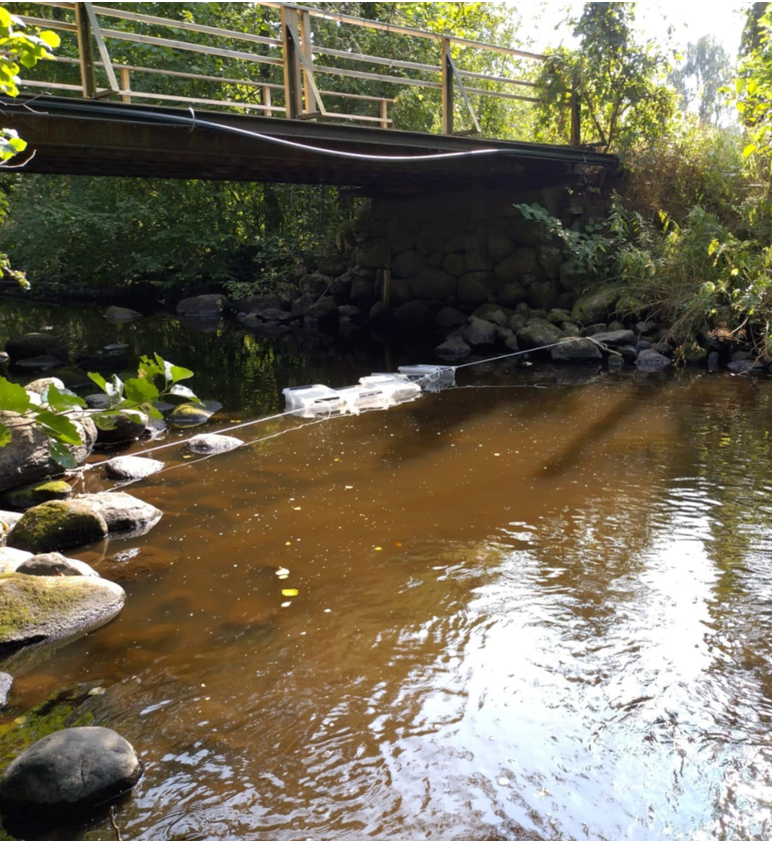
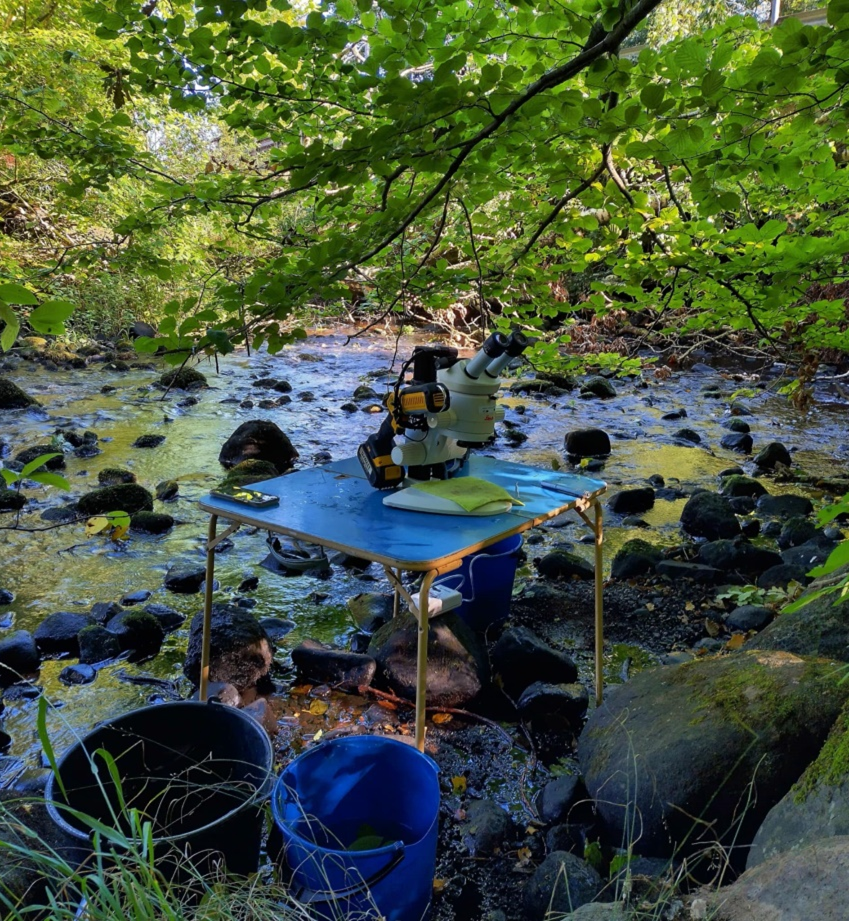
Figure A. Cage infestations of M. margaritifera in Vramsån. The photo (left) shows cages used to hold fish and mussels for infestation. The photo (right) shows an in-situ dissecting microscope setup for monitoring glochidia viability and glochidia rates on fish.
Annually, infested host fish have been released at four locations in Vramsån: Årrod and Grärs Köpinge since 2020, Lilla Årrod since 2021 and Gringlestad since 2025 (Figure B). Approximately 1500 infested fish in total have been returned to Vramsån, with ~60 glochidia per fish. This equates to ~90,000 encysted glochidia being reintroduced to Vramsån.
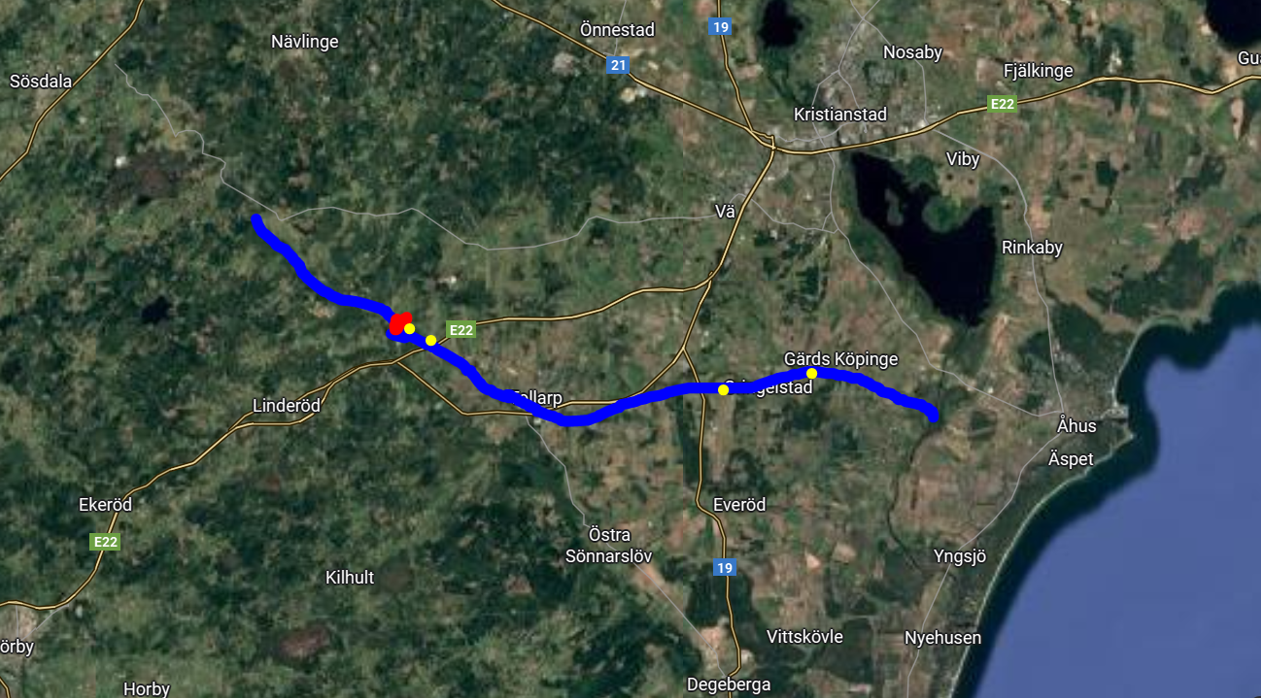
Figure B. Margaritifera margaritifera collection locations (red) for cage infestations and subsequent infested fish release sites (yellow) for mussel reintroduction in Vramsån.
Margaritifera margaritifera in Rönne å
The Rönne river is one of the longest waterways in Skåne with a length of ~85 km. Together with its tributaries, the river also forms one of the largest catchment areas at 1,897 m2. Small populations of the endangered M. margaritifera are found in tributaries, but are assumed to have existed in the main river in the past. Habitat restoration and dam removal will create the conditions for M. margaritifera to recolonise areas and have improved regeneration. This is because their host fish will increase in number and be able to spread the mussels within the catchment area to newly created habitats.
Conservation action for M. margaritifera in Skärån, a tributary of Rönne å, uses manual infestations. Similarly to cage infestations, host fish are electric fished from the river and temporarily maintained in cages in-situ. Gravid M. margaritifera individuals are collected from an adjoining sub-catchment and transported to a laboratory where they are induced to release glochidia in more controlled environmental/temperature conditions (Figure C). Glochidia are then exposed to the caged fish before returning to Skärån.
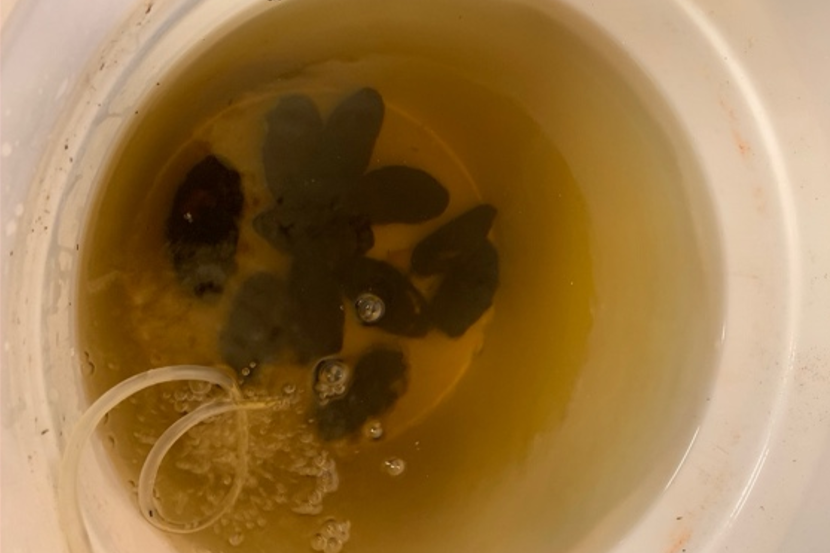
Figure C. Margaritifera margaritifera being maintained in the laboratory. Use of river water reduces the stress of collection and transportation. Aeration maintains dissolved oxygen at 100% saturation, as well as maintains a gentle water flow and keeps potential food particles in suspension. Water temperature is monitored and, under control, allowed to increase slowly to induce brooding females to release glochidia.
Annually, infested host fish have been released in the river Skärån in the Söderåsens national park since 2021 (Figure D). Manual infestation at Klövabäcken was attempted in 2024. Approximately 400 infested host fish in total have been returned to Rönne å, with ~120 glochidia per host fish. This equates to ~48,000 encysted glochidia being reintroduced to Rönne å.
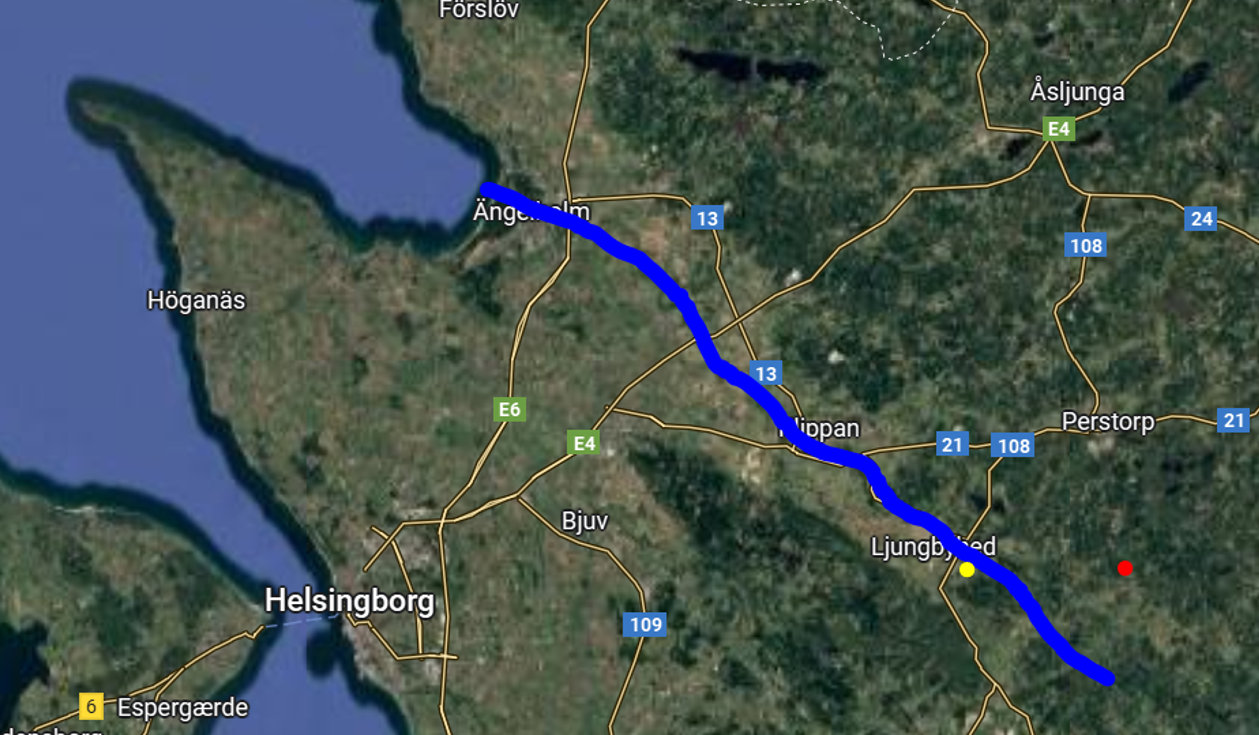
Figure D. Locations of M. margaritifera collection (red) and infested host fish collection & release location, Söderåsens (yellow), for mussel reintroduction to Skärån, a tributary of Rönne å.
Unio crassus in Verkeån
The river Verkeån has a catchment area of 153 km2 and the total length with tributaries is about 50 km long with a fall height of around 180 m. Despite high water quality of the Verkeån river, only nine fish species are found, including lamprey, zander, bullhead, eel and trout. Several of these species can be host fish for mussels. Shell finds of the thick-shelled mussel (U. crassus) show that the species was present in the river, although no live finds have been found recently. The thick-shelled mussel is currently endangered in Sweden and listed in the Habitats Directive as a priority species. In combination with the release of thick-shelled mussels, LIFE CONNECTS will contribute to the reappearance of the mussel in Verkeån. Dam removal measures will significantly improve fish migration, hydrology, water quality, biodiversity, fish production and habitats in the Verkeån river and thus improve the conservation status of the project’s target and priority species in the conservation plans for the Natura 2000 sites.
Conservation action for U. crassus in Verkeån uses manual infestations. Annually, infested host fish have been released both upstream of the Hallamölla waterfall and downstream of the Hallamölla waterfall since 2021 (Figure E). Approximately 2800 infested host fish in total have been returned to Verkeån, with ~12 glochidia per host fish. This equates to ~33,600 encysted glochidia being reintroduced to Verkeån.
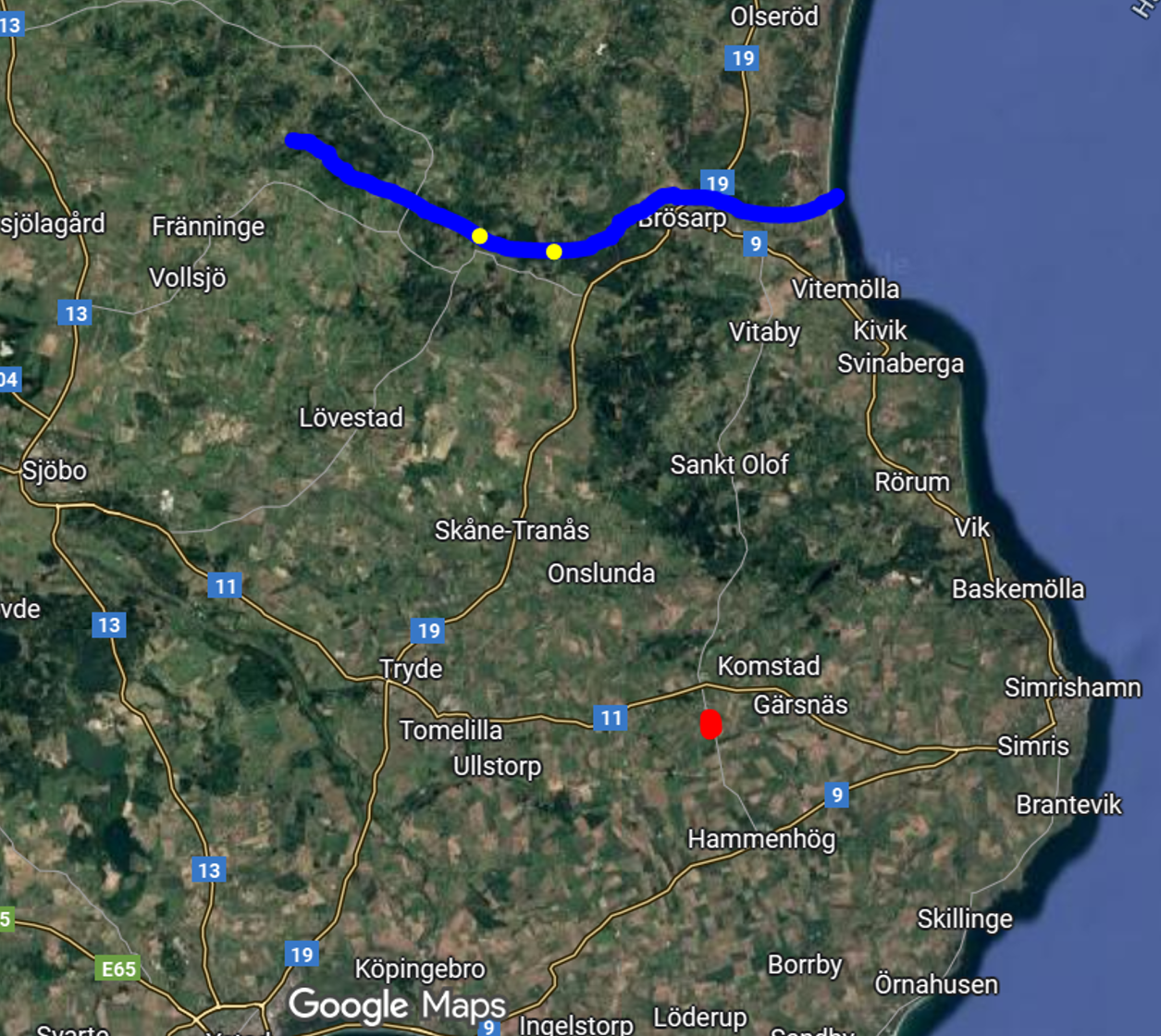
Figure E. Locations of U. crassus collection (red) for manual infestations and infested host fish release: upstream of Hallamölla; and Hallamölla (yellow), for mussel reintroduction into Verkeån.
Unio crassus in Vramsån
Whilst the thick-shelled mussel (U. crassus) has been found in Vramsån (Figure F), the regeneration of this mussel species is considered poor and measures are needed for both the mussels and their host fish. As discussed above with the freshwater pearl mussel, when the river is opened for fish migration, the amounts of host fish for the thick-shelled mussel will increase, which promotes the reproduction of mussels in the long term. To strengthen mussel populations in the short term, reintroduction of mussels is also needed.
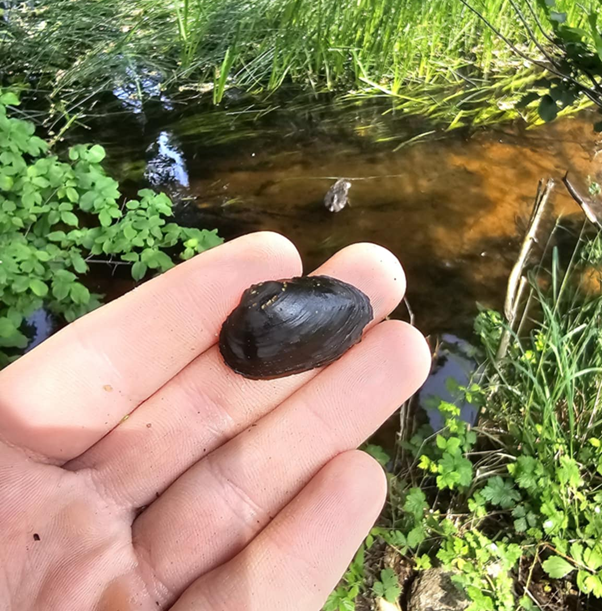
Figure F. A juvenile U. crassus in Vramsån.
Conservation action for U. crassus in Vramsån uses both manual and cage infestations. Annually, infested host fish have been released at two locations: Tollarp and Grärs Köpinge since 2021 (Figure G). Approximately 1800 infested host fish in total have been returned to Vramsån, with ~34 glochidia per host fish. This equates to ~61,200 encysted U. crassus glochidia being reintroduced to Verkeån.
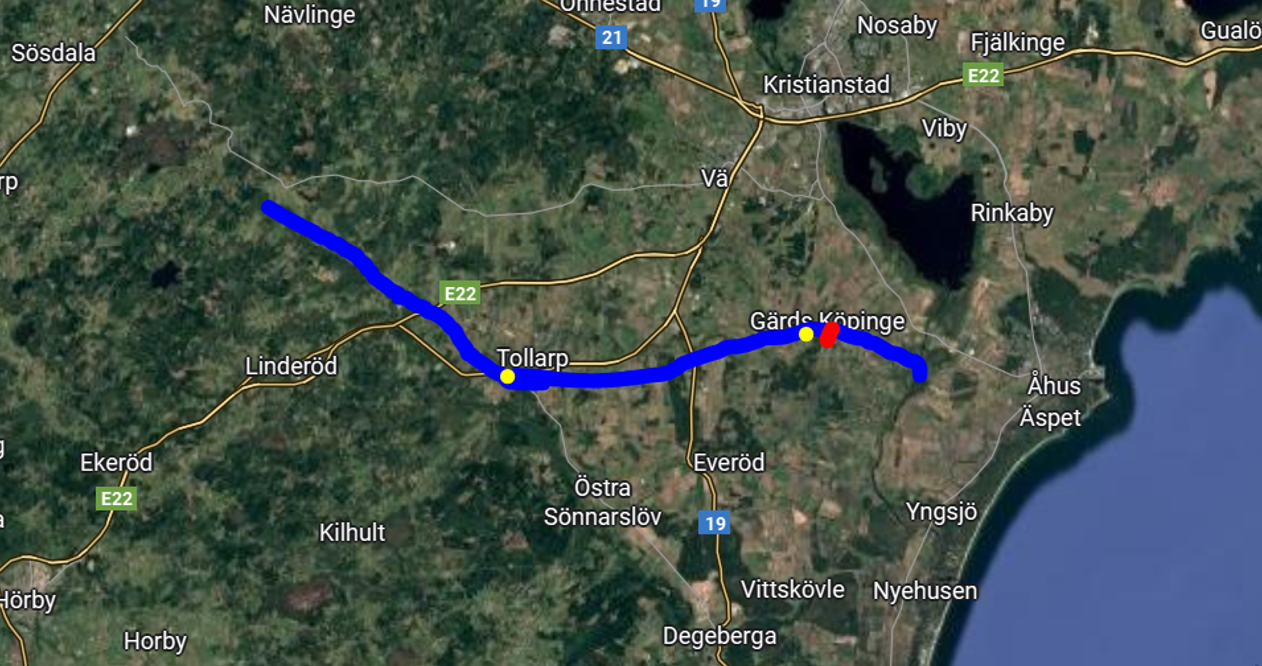
Figure G. Locations of U. crassus collection (red) for manual & cage infestations, and infested host fish release: Tollarp; and Grärs Köpinge (yellow), for mussel reintroduction in Vramsån.
Many thanks to our project partners and supporters
The FBA joined the knowledge exchange trip to Sweden as part of the LIFE R4ever Kent project. Funded by the EU LIFE programme, the project aims to restore, revitalise and revive the River Kent and make it more resilient to future challenges.
LIFE R4ever Kent is led by Natural England, working in partnership with the Environment Agency, South Cumbria Rivers Trust, and with Freshwater Biological Association.
Further Reading
Brian, J., Ollard, I. & Aldridge, D. (2021) Don’t move a mussel? Parasite and disease risk in conservation action. Conservation Letters, 14 (4), Article e12799.
Ferreira-Rodríguez, N. et al. (2025) Knowledge and uses of freshwater mussels in Europe. Ambio. https://doi.org/10.1007/s13280-025-02288-5
Rock, S. L., Watz, J., Nilsson, P. A., Österling, M. (2022). Effects of parasitic freshwater mussels on their host fishes: a review. Parasitology, 149, 1958-1975. https://doi.org/10.1017/s0031182022001226
Rock, S. L. (2024a). Aquarium setup for the long-term housing of Pseudanodonta complanata (Bivalvia: Unionidae) towards captive breeding success. Aquatic Conservation: Marine and Freshwater Ecosystems, 34(7), Article e4218. http://dx.doi.org/10.1002/aqc.4218
Rock, S. L. (2024b). First observation of a spawning mantle display in a European unionid mussel. Ecology and Evolution, 14(7), Article e70016. http://doi.org/10.1002/ece3.70016
Rock, S. L., Blomqvist, M., Watz, J., Nilsson, P. A., Calles, O., & Österling, M. (2025). Parasitic freshwater mussels impact the shoaling behaviour and habitat use of their host fish. Manuscript.
Rock, S. L., Elmlund, A., Watz, J., Nilsson, P. A., Calles, O., & Österling, M. (2025). A habitat and a parasite: The impact of adult and larval parasitic freshwater mussels on habitat choice and predator-prey interactions between a host fish and its prey. Ecology & Evolution, 15(12), e72601. https://doi.org/10.1002/ece3.72601
Rock, S. L., Watz, J., Nilsson, P. A., Calles, O., & Österling, M. (2025). Parasitic mussels induce upstream movement in their fish hosts: early evidence of extended phenotype. Behavioral Ecology, 36(4), Article araf043. https://doi.org/10.1093/beheco/araf043
Rock, S. L., & Townsend Jr, V.R. (2025). A scanning electron microscopy based survey of the impact of infestation by parasitic freshwater mussel glochidia upon the gill morphology of two species of salmonid fish. Parasitology International, 108, Article 103071. https://doi.org/10.1016/j.parint.2025.103071
Rock, S. L., & Österling, M. (2025). Eels as Hosts for Parasitic Mussels: The Importance of Endangered Species Co-Management. Animal Conservation. https://doi.org/10.1111/acv.70026
Zieritz, A. et al. (2025). A global meta‐analysis of ecological functions and regulating ecosystem services of freshwater bivalves. Limnology and Oceanography, 70(10), 2982-2997. https://doi.org/10.1002/lno.70190
Further FBA reading
The Freshwater Biological Association publishes a wide range of books and offers a number of courses throughout the year. Check out our shop here.



Get involved
Our scientific research builds a community of action, bringing people and organisations together to deliver the urgent action needed to protect freshwaters. Join us in protecting freshwater environments now and for the future.

NEW COURSE: Pond Restoration Training: North West England on 6 & 7 July 2026. From £250.00
Ponds are increasingly recognised as critical features for biodiversity conservation across UK landscapes. This two-day course will introduce participants to the science and best practice of pond restoration.
Helen Greaves of the Pond Restoration Research Group at University College London (UCL) is a co-founder of the Norfolk Ponds Project (NPP) and Executive Director of the NPP Community Interest Company (CIC). With over 15 years’ experience restoring ponds and researching their ecological recovery, and following publication of the recent Guide to the Restoration, Creation and Management of Ponds, Helen is keen to share key lessons and practical insights from both the UCL and NPP teams.
The course will include a combination of lectures, workshops, and field visits focused on the restoration of degraded overgrown ponds and in-filled “ghost ponds”.
Participants will be introduced to the scientific evidence underpinning pond restoration, including the benefits for freshwater and terrestrial biodiversity. The course will also cover the key DOs and DON’Ts of restoration, including pond selection and important considerations during the restoration process.
Field visits will explore two contrasting pond landscapes typical of West Lancashire. One site is situated within a lowland floodplain landscape, while the other lies within a higher arable setting adjacent to a nature reserve. These visits will provide an opportunity to compare ponds across different land uses, including farmland and conservation-focused landscapes. Participants will consider how landscape context influences restoration potential, management approaches, and ecological outcomes, including the specific challenges and opportunities associated with restoring existing ponds and resurrecting ghost ponds.
The course will also address approaches to engaging landowners, farmers, and local communities in pond conservation, alongside practical routes for securing funding to support restoration work.
Participants on all FBA courses must be 18 years and above.
Location: West Lancashire (near Ormskirk)
Tutor: Helen Greaves
Price: £275 for non-members, £250 for members
Please click on the following link to download and complete the booking form then email to info@fba.org.uk: FBA Courses Booking Form.docx
TO AVOID POSTAL CHARGES PLEASE SELECT ‘PICK UP’ OPTION AT CHECKOUT.
Please note: Payment must be made in full via the website in order to secure your place on this course.