Could citizen scientists help document spatial and temporal change in filamentous algae? The case of the River Wye.
13 April, 2026
By Martyn Kelly (1), Jason Doe (2), Luke Walters (2) and Bill Brierley (3).
(1) Bowburn Consultancy / University of Nottingham; MGKelly@bowburn-consultancy.co.uk; (2) Environment Agency; (3) independent consultant.
In this article, FBA Fellow Martyn Kelly, Environment Agency biologists Jason Doe and Luke Walters, and former FBA Chief Executive Bill Brierley reanalyse a dataset from the River Wye to document spatial and temporal variation in the attached algae, and what this means for managing this iconic river.
Edited by Rachel Stubbington, Nottingham Trent University
Rachel is both a Fellow of the Freshwater Biological Association and long-standing Editor of FBA articles. If you would like to submit an article for consideration for publication, please contact Rachel at: rachel.stubbington@ntu.ac.uk
Introduction
Concern about the state of UK freshwaters is greater than ever, but why this decline is happening, and what can be done to reverse it, is often more complicated than many media reports suggest. The River Wye – the UK’s fifth longest river – is a case in point. Although its degradation by human activities is well-documented, it is not, as one campaigner quoted in The Guardian in 2024 said “almost dead”. Nor is the cause cited in that article – inorganic nutrients – beyond dispute; the Wye mostly achieves its statutory targets for phosphorus. Given the right tools, citizen scientists could build on the momentum generated by campaigners and create an evidence base that informs this ongoing debate.
Local volunteers are already collecting water samples on the Wye and analysing nutrient concentrations to identify potential pollution hotspots. Phosphorus, the primary focus of this sampling, is not toxic but, as the nutrient that normally limits algal growth, it can fuel the proliferation of filamentous and suspended algae, damaging river ecology. Filamentous algae smother the bed, restricting growth of other macrophytes and, along with suspended algae, sucking oxygen that fish and invertebrates need out of the water at night, when photosynthesis stops. However, until recently, filamentous algae surveys in the Wye were limited. Maybe citizen scientists could start gathering evidence on filamentous algae as well as water chemistry?
Rapid assessment of filamentous algae in the Wye
RAPPER (Rapid Assessment of PeriPhyton Ecology in Rivers) is a rapid technique that citizen scientists can use to estimate benthic algal cover (Kelly et al. 2016; Woodfield et al. 2023). A RAPPER survey assesses the ecological risk from filamentous algal growth as “not at risk” (≤5% cover), “maybe at risk” (>5–25% cover) or “at risk” (>25% cover). Environment Agency (EA) biologists, meanwhile, had adapted RAPPER for use on the River Wye as a less resource-intensive alternative to formal Water Framework Directive assessment methods, enabling them to visit more sites more often.
In this article, we reanalyse EA results using the “citizen science” version of RAPPER (available at https://castco.org/knowledge-categories/biological-monitoring-methods) to help understand the scale of spatial and temporal variability in algae recorded by RAPPER assessments, which will inform interpretation of future survey data.
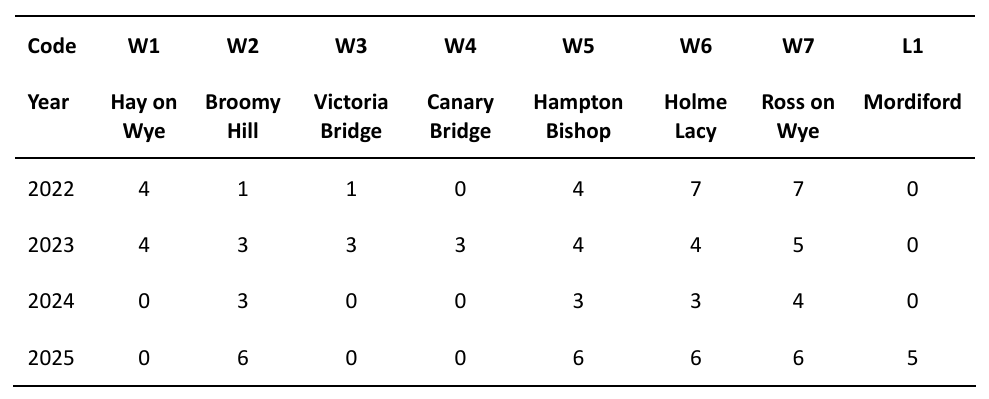
Seven sites on the English sections of the Wye, from Hay-on-Wye to Ross-on-Wye, were surveyed up to 7 times during the growing season between 2022 and 2025 (Figure 1; Table 1). Mordiford, a site on the lower Lugg (a major Wye tributary) was added in 2025 for comparison with the Wye.
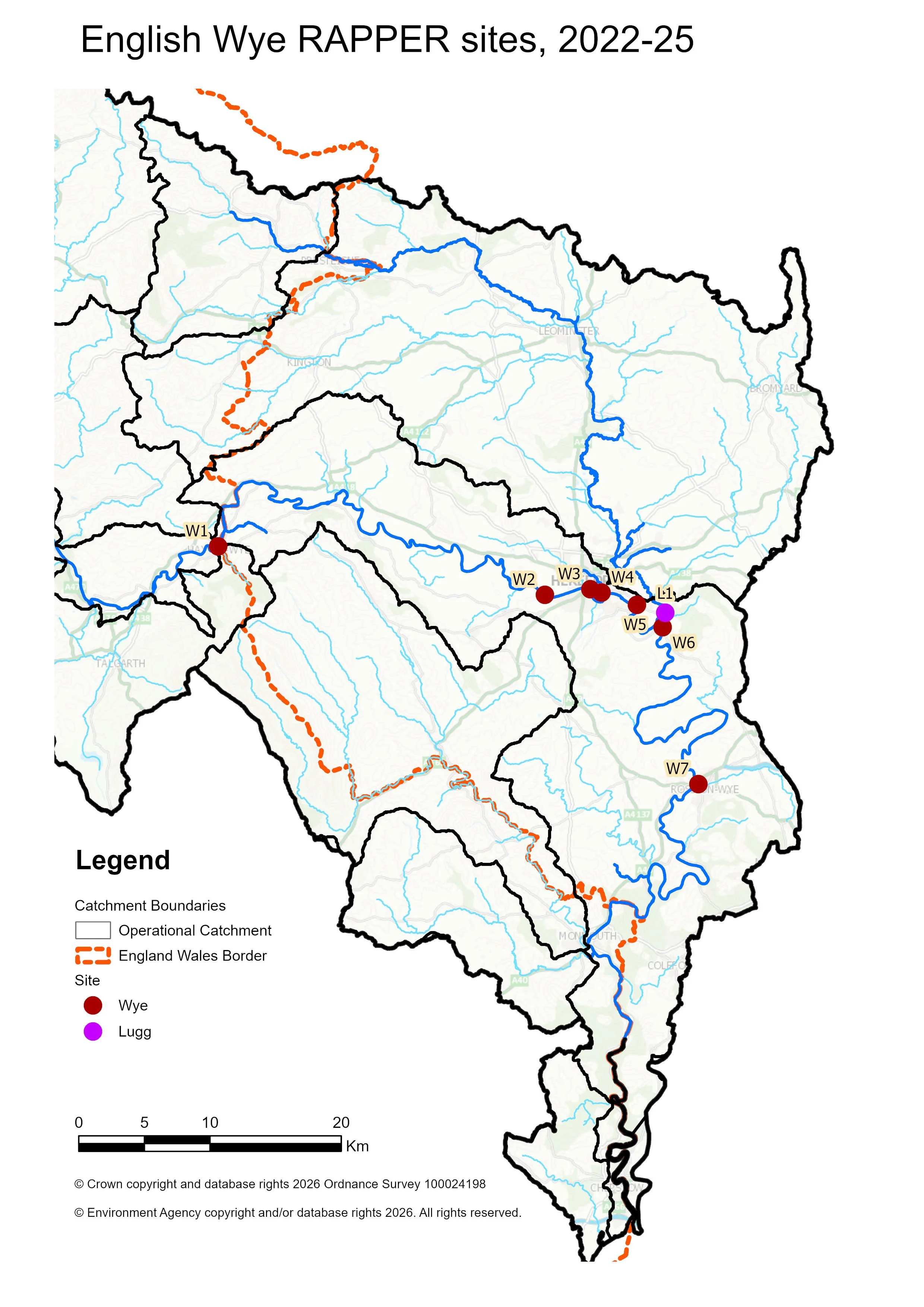
Figure 1. Map of the Wye catchment showing survey site locations.
Table 1. Surveys per site. Codes match those on Figure 2. L, Lugg; W, Wye.
RAPPER was originally designed for use in small rivers, in which the whole width can be surveyed (Kelly et al. 2016). The Wye, however, is 30–60 m wide in the sections assessed herein, so permanent 10 m × 5 m quadrats identified by fixed features were instead established, enabling surveyors to consider a consistent area (Figure 2). Algal growths were identified to genus in the laboratory and cover was assessed with the 9-point scale used for standard (i.e. ‘LEAFPACS’) macrophyte assessments (WFD-UKTAG 2014).
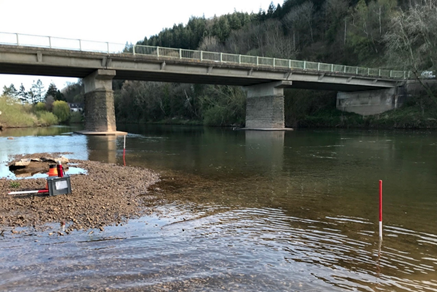
Figure 2. The River Wye at Holme Lacy; red poles mark the extent of the survey reach. Credit: Jason Doe.
Twenty taxa were recorded, with the greatest number of records for the green alga Cladophora glomerata, followed by the red alga Hildenbrandia rivularis, the brown alga Heribaudiella fluviatilis and Melosira varians (Bacillariophyta; Figure 3). Of these, C. glomerata and M. varians had the highest cover, often smothering ≥20% of the bed. The uppermost site (Hay-on-Wye) often had high algal cover with Oedogonium and Spirogyra being the dominant green algae.
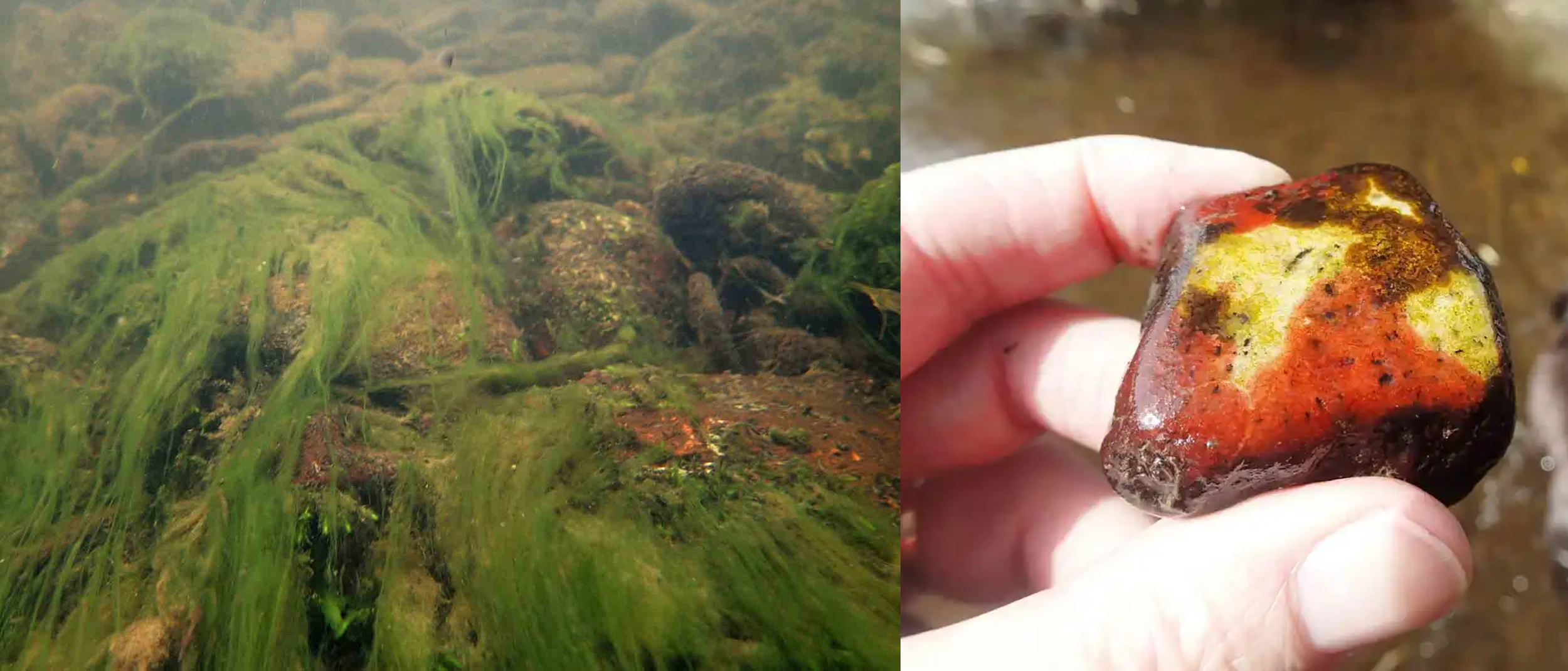
Figure 3. Surveyed macroalgae: left: Cladophora glomerata at Hay-on-Wye; right: Heribaudiella fluviatilis and Hildenbrandia rivularis at Broomy Hill. Credit: Martyn Kelly.
Cover varied considerably both between and within years (Figure 4). Dry periods (such as spring and early summer 2025) were associated with relatively high cover whilst the summer of 2024, when heavy rainfall led to high flows, was noticeable for relatively low algal cover throughout the summer, and only Holme Lacy exceeded 25% cover.
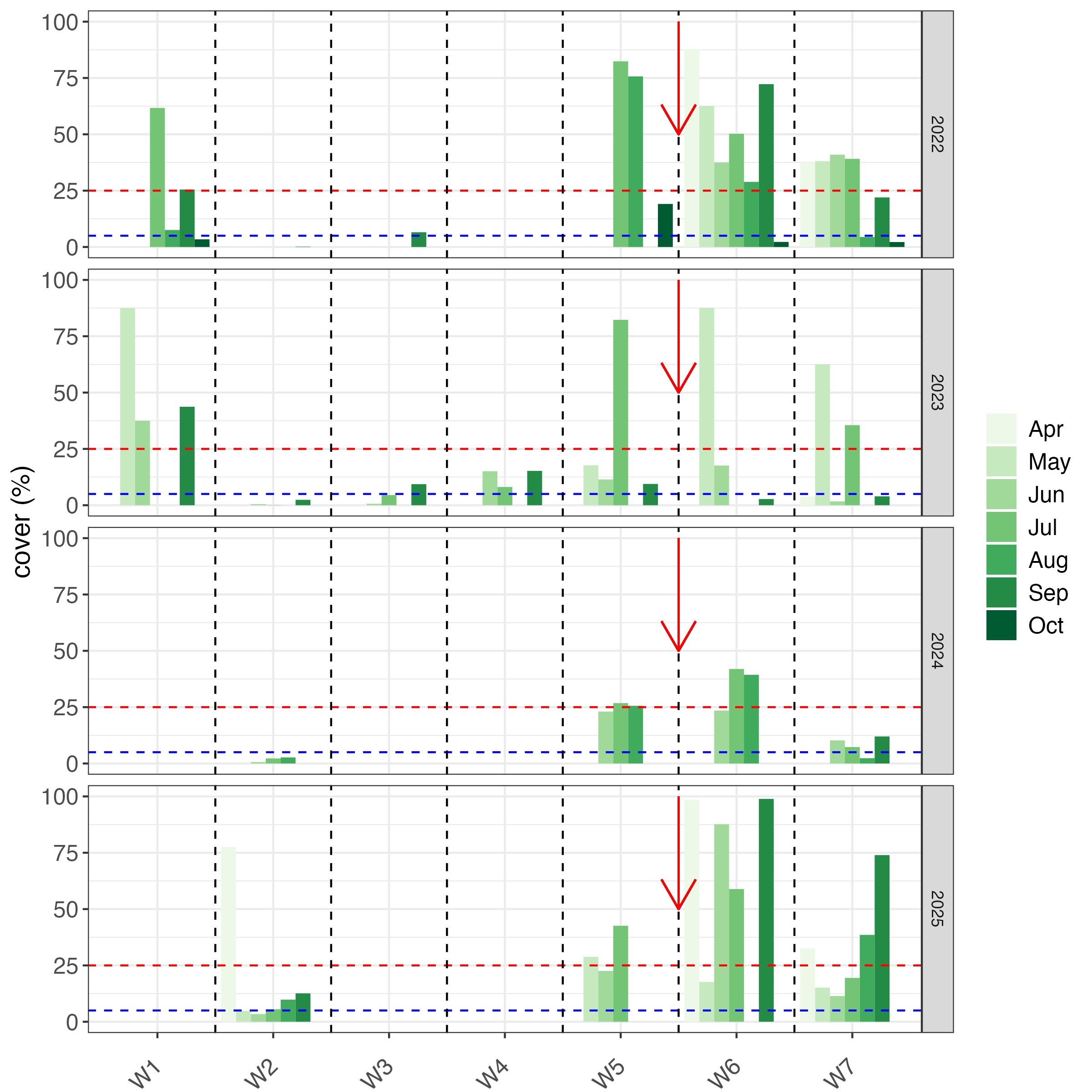
Figure 4. Monthly variation in total algal cover at sites W1–W7 on the River Wye. The red arrow indicates the point where the River Lugg joins the River Wye. Blue and red lines indicate the thresholds for “not at risk” (≤5%) and “at risk” (>25%), respectively.
This variability, which was particularly pronounced at the higher end of the cover scale, highlights that a single assessment of filamentous algae (as is done for routine LEAFPACS assessments) may provide limited insight into site condition. It is probably explained by a range of interacting factors, with nutrients, warm weather and low flows encouraging growth, whilst spates remove algae. A face-value risk assessment based on one annual visit could give any answer from “not at risk” to “at risk”, depending on timing. Multiple surveys over the growing season generate a more holistic picture of condition. Average condition over the growing season is one option for judging condition, but an upper percentile of measurements – “the worst that this river could be”– is also a possibility. Such an assessment depends on the capacity for regular surveys and, as such, is ideally suited to citizen scientists.
As it was originally designed for professional biologists, adapting RAPPER for citizen scientists involved some simplification. One change recommended by Woodfield et al. (2023) was the use of three categories to describe observed algae cover. Comparison of a 5-point scale (CEN 2009) and this 3-point scale with the standard 9-point scale indicated differences in estimated cover, but assessments were rarely assigned to a different risk category (Figure 5).
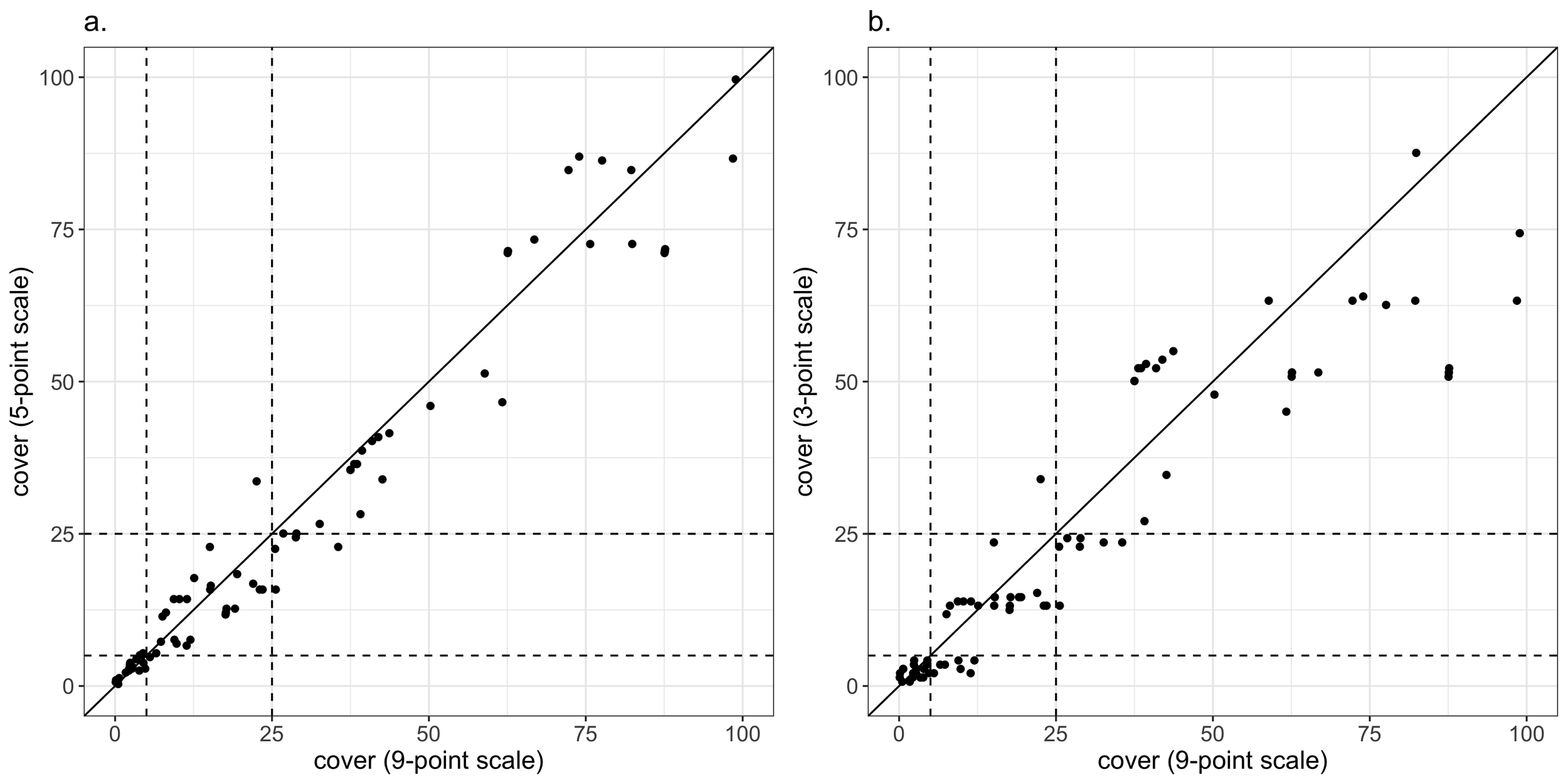
Figure 5. Estimated algal cover based on the LEAFPACS 9-point cover scale (x axis) and either a 5-point (a) or 3-point (b) cover scale.
Concluding thoughts
Although the data presented here were generated by professional biologists, the outcomes match our experience when using RAPPER with citizen scientists around the country, including on the nearby River Usk. RAPPER provides an extra component to citizen science monitoring in the Wye which has, hitherto, focussed on water chemistry. However, as phosphorus has ecological impacts primarily due to its use by algae and higher plants, it is important that algal and plant survey data supplement chemical measurements. Our results suggest that extending RAPPER to citizen scientists is a plausible next step to improve understanding of complex waterbodies such as the River Wye.
The concept of “plant blindness”, a cognitive bias towards overlooking the plants around us, has become established (Balding & Williams, 2016). A freshwater variant is to ignore the algae that are natural components of rivers, except when they proliferate to the point where they compromise aesthetic, recreational or other river uses or, in the case of the Wye, replace visually attractive beds of water crowfoot. We hope that methods such as RAPPER could alleviate such situations by giving citizen scientists an objective means of tracking the waxing and waning of algal growths. The data citizen scientists generate could be genuinely informative for Rivers Trusts and regulators but, equally importantly, could raise awareness of the role that algae play in river ecology amongst volunteers and activists.
Resources
The RAPPER manual is available onthe CaSTCo website.
The CaSTCo website also explains how RAPPER fits into a “weight of evidence” approach accessible to citizen scientists.
Three blog posts explaining the reasons why filamentous algae proliferate in rivers: The greening of our rivers (1), (2) and (3).
References
Balding, M. & Williams, K.J. 2016. Plant blindness and the implications for plant conservation. Conservation Biology 30: 1192–1199. https://doi.org/10.1111/cobi.12738
Kelly, M.G., Krokowski, J. & Harding, J.P.C. 2016. RAPPER: A new method for rapid assessment of macroalgae as a complement to diatom-based assessments of ecological status. Science of the Total Environment 568: 536–545. https://doi.org/10.1016/j.scitotenv.2015.12.068
WFD-UKTAG 2014. River Assessment Method Macrophytes and Phytobenthos: Macrophytes (River LEAFPACS2). Available via: https://www.wfduk.org/resources/rivers-macrophytes
Woodfield, K. et al. 2023. Feeling our way towards macroalgal assessment for citizen scientists. https://www.fba.org.uk/articles/feeling-our-way-towards-macroalgal-assessment-for-citizen-scientists
Further FBA reading
The Freshwater Biological Association publishes a wide range of books and offers a number of courses throughout the year. Check out our shop here.



Get involved
Our scientific research builds a community of action, bringing people and organisations together to deliver the urgent action needed to protect freshwaters. Join us in protecting freshwater environments now and for the future.

NEW COURSE: Pond Restoration Training: North West England on 6 & 7 July 2026. From £250.00
Ponds are increasingly recognised as critical features for biodiversity conservation across UK landscapes. This two-day course will introduce participants to the science and best practice of pond restoration.
Helen Greaves of the Pond Restoration Research Group at University College London (UCL) is a co-founder of the Norfolk Ponds Project (NPP) and Executive Director of the NPP Community Interest Company (CIC). With over 15 years’ experience restoring ponds and researching their ecological recovery, and following publication of the recent Guide to the Restoration, Creation and Management of Ponds, Helen is keen to share key lessons and practical insights from both the UCL and NPP teams.
The course will include a combination of lectures, workshops, and field visits focused on the restoration of degraded overgrown ponds and in-filled “ghost ponds”.
Participants will be introduced to the scientific evidence underpinning pond restoration, including the benefits for freshwater and terrestrial biodiversity. The course will also cover the key DOs and DON’Ts of restoration, including pond selection and important considerations during the restoration process.
Field visits will explore two contrasting pond landscapes typical of West Lancashire. One site is situated within a lowland floodplain landscape, while the other lies within a higher arable setting adjacent to a nature reserve. These visits will provide an opportunity to compare ponds across different land uses, including farmland and conservation-focused landscapes. Participants will consider how landscape context influences restoration potential, management approaches, and ecological outcomes, including the specific challenges and opportunities associated with restoring existing ponds and resurrecting ghost ponds.
The course will also address approaches to engaging landowners, farmers, and local communities in pond conservation, alongside practical routes for securing funding to support restoration work.
Participants on all FBA courses must be 18 years and above.
Location: West Lancashire (near Ormskirk)
Tutor: Helen Greaves
Price: £275 for non-members, £250 for members
Please click on the following link to download and complete the booking form then email to info@fba.org.uk: FBA Courses Booking Form.docx
TO AVOID POSTAL CHARGES PLEASE SELECT ‘PICK UP’ OPTION AT CHECKOUT.
Please note: Payment must be made in full via the website in order to secure your place on this course.