A Reverence for Rivers: in conversation with the author Kurt Fausch
4 February, 2026
It was an absolute pleasure to catch up with Dr. Kurt Fausch to discover more about ‘A Reverence for Rivers: Imagining an Ethic for Running Waters’.
Join us for a delightful dive into the inspiration and science that motivated Kurt’s latest book, and be enthralled by his optimism for future river conservation and our relationship with these incredible freshwater ecosystems.
So first, what was your main motivation to write the book?
As I was winding down a 35-year-long research career on the conservation of rivers, their biota, and linkages to riparian zones, I realised that we scientists need to connect more directly with a broad audience on what is essential about our relationship with rivers.
In two books for general audiences, I’ve pondered that question: “Why would people, regular people, care about rivers, even going beyond water to drink and grow crops, and fish to catch?”
The second book, titled A Reverence for Rivers: Imagining an Ethic for Running Waters (2025. Oregon State University Press) focuses on environmental history, Indigenous and western worldviews, and the ethical quandaries that all rivers present.
The book holds stories about seven rivers throughout the world I came to know well, the aquatic and riparian organisms and humans that rely on them, and our relationships with and values for these places. These are followed by three synthesis chapters (also written as stories), addressing questions of which rivers to protect, our inherent right to use water from them, and what paths forward might lead to resilience for rivers.
I conclude with an essay pondering our relationship with rivers, and an epilogue about the solace that rivers provide. These stories present an accessible gateway for interested lay readers, and scientists and students alike.
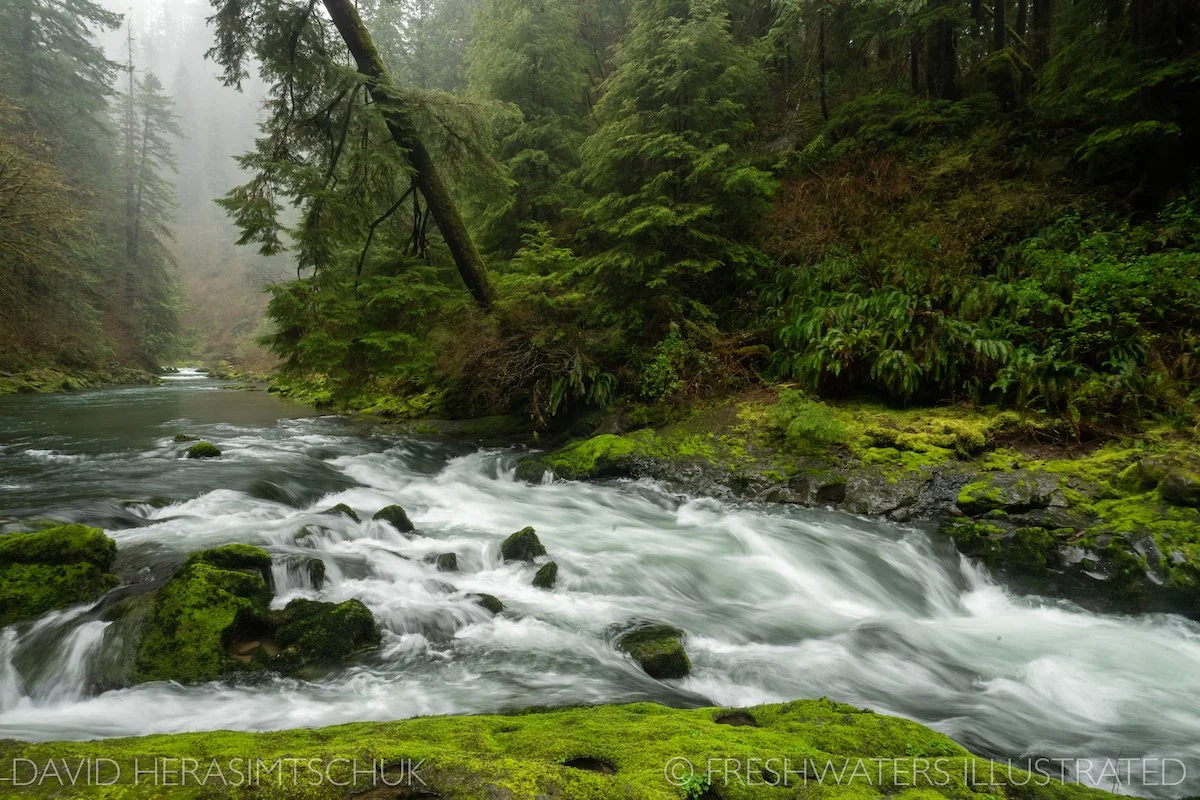
A coastal river in Oregon, featured in the book (image: D. Herasimtschuk, Freshwaters Illustrated).
You mention in the trailer for the book that "Rivers are much more than channels that carry water. They're almost like a living organism." Could you tell us a little more about this please?
This leads to the backstory behind both books I’ve written. In 1988 I was invited to the Charr and Masu Salmon Symposium in Sapporo, Hokkaido, Japan. I had studied brook charr for my graduate research and in my early career, and met many charr biologists from throughout the world, including the late Chris Mills of the FBA who studied Arctic charr in Windermere, and Shigeru Nakano from Japan.
Nakano’s work on behavioural ecology of Dolly Varden and whitespotted charr interacting in Hokkaido streams was so amazing, I began collaborating with him. We ultimately laid a foundation for understanding how these species coexist in Hokkaido streams from the local pool scale to the zoogeographic scale of the whole island.
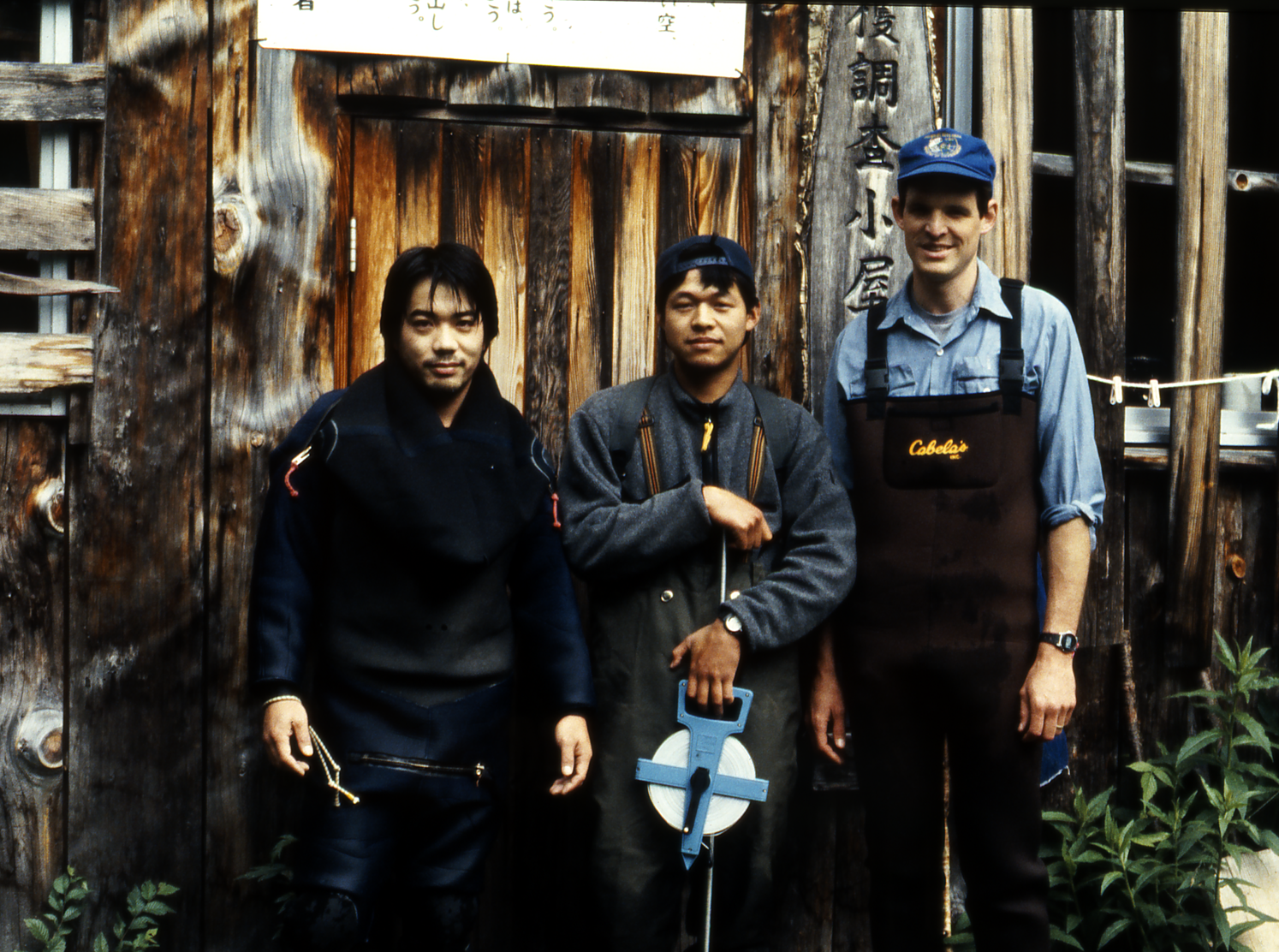
Shigeru Nakano, Satoshi Kitano, and Kurt Fausch (left to right) conducting research on native charr in the mountains of Hokkaido, Japan (ca., 1991).
Nakano went on to conduct pioneering research showing the strong linkages between streams and their riparian zones, through the invertebrates that flow in both directions. He covered long segments with mesh greenhouses to experimentally cut off these flows, and found that about half or more of the aquatic and terrestrial animals left because about half or more of their food was excluded. Fish emigrated because terrestrial invertebrates were no longer falling into the stream, and bats and spiders declined because emerging adult aquatic insects no longer reached the riparian zone.
This showed ecologists that far from being merely channels that carry water, streams support a rich diversity of riparian bats, birds, lizards, and spiders, for example, and shape how these ecosystems function. Likewise, forests supply terrestrial invertebrates that can make up about half the annual energy budget for fish in small streams. If we want to have productive streams and forests, we need to keep them interacting with each other.
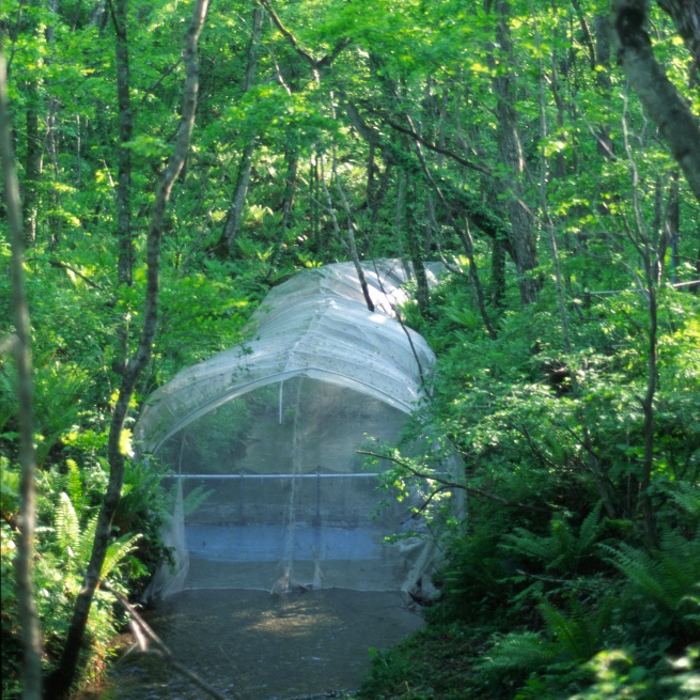
A greenhouse pioneered by Shigeru Nakano to experimentally cut off flows of invertebrates between a Hokkaido stream and its riparian zone (image: C. Baxter).
By 2000, Shigeru Nakano had become a rock star in ecology, as people read his amazing work. Sadly, he was killed in a tragic accident and lost at sea off Baja California while visiting research sites of a US ecologist located on desert islands offshore, after their boat capsized in a violent storm as they returned.
I travelled back to Japan, followed up on his research legacy, and we made a documentary film Riverwebs; about Nakano’s life and our collaboration. The documentary is the work of amazing storyteller and videographer Jeremy Monroe and his group at Freshwaters Illustrated.
Afterwards, I kept pondering why people would want to conserve rivers, and wanted to tell more of the story of our research in Japan and Colorado. This led to writing the first book, For the Love of Rivers (see www.riverethic.com for both books), which offers a memoir to draw a general audience into the world that stream ecologists experience, and culminates with the beginnings of a personal philosophy about why rivers are essential for humans.
“People come to the river for tangible and intangible reasons – for shade, walking and biking, angling and birdwatching, and often just solace to sooth the difficulties and trauma that each of us experience. Rivers are essential for us to be whole people.”
And what are your main hopes for inspiring people's relationships with rivers after reading the book?
I live in the very dry climate of Colorado, where too little water falls from the sky as rain or snow to grow lawns or crops. Everything is irrigated with water that falls as snow in the mountains and is stored in reservoirs when the snow melts in June and July. Very few residents think about where the water they use comes from, or what it will take to have real rivers as the climate continues to warm and become drier.
Despite this lack of public awareness about rivers, data from six trail cameras arrayed along the local river in our city (about 140,000 people) show that about 100,000 people annually are walking past any given point along the river, proving how essential this environment is for people in my city. People come to the river for tangible and intangible reasons – for shade, walking and biking, angling and birdwatching, and often just solace to sooth the difficulties and trauma that each of us experience. Rivers are essential for us to be whole people.
My goal is to help people understand what rivers really mean to us as humans, including for the water we drink and use to grow crops, but also for intangible things that are, as Aldo Leopold wrote, “beyond the reach of language”. Only then will we have advocates for real rivers.
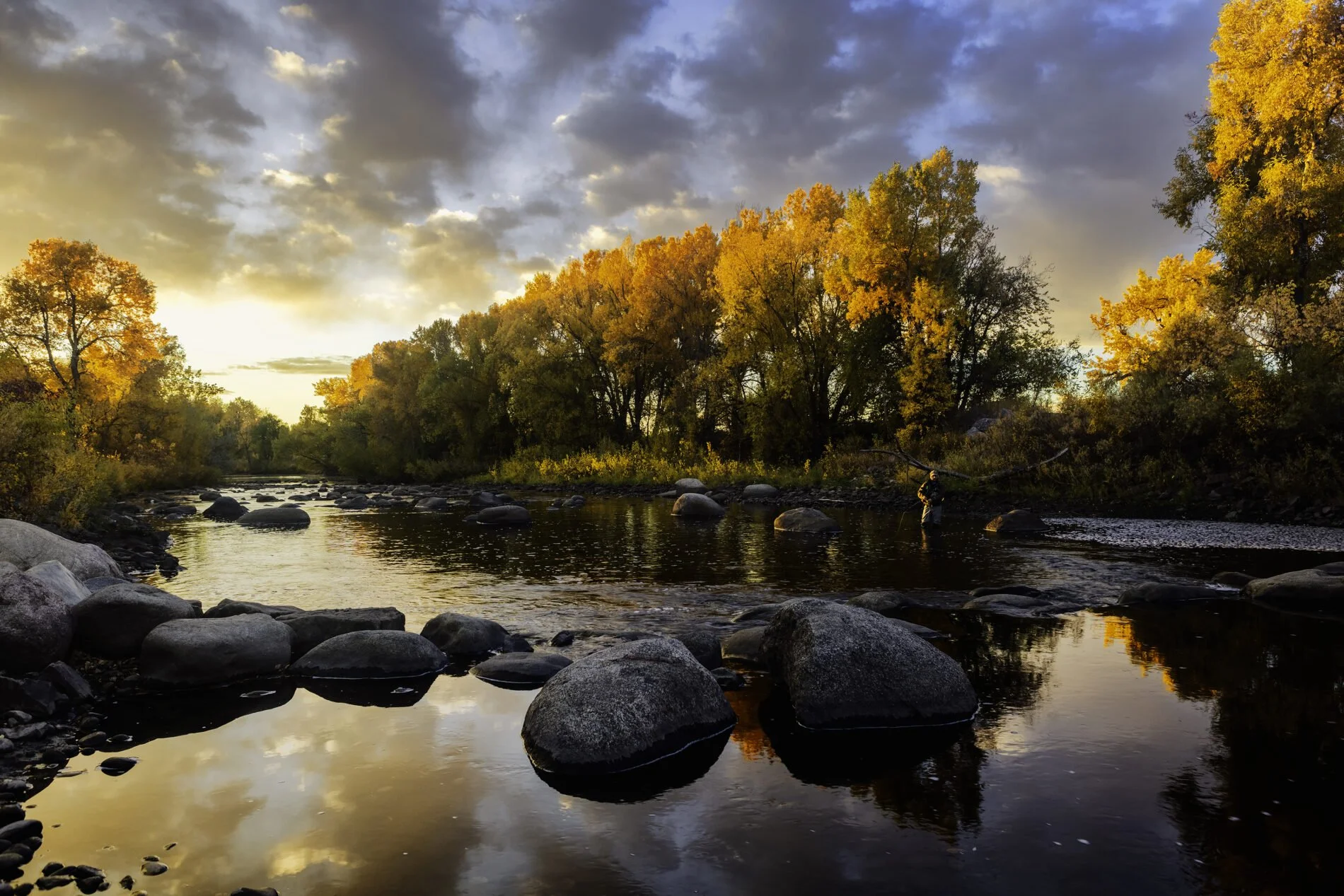
The Cache la Poudre River as it runs through Fort Collins, Colorado, a key source of water and solace in a dry climate.
How do you feel that we can best reconcile what rivers need with how we live?
This is the role of the sciences of hydrology and aquatic ecology, and of water management and water policy. My hope is that once people become inspired to clamour for real rivers, then the hard-won science that has been developed can be brought to bear on the problems. Yet, without that public advocacy, science can be easily ignored. Both are critical for having real rivers.
“My hope is that once people become inspired to clamour for real rivers, then the hard-won science that has been developed can be brought to bear on the problems. Yet, without that public advocacy, science can be easily ignored. Both are critical for having real rivers.”
You have referenced on your website a Stephen Jay Gould quote regarding the necessity of love for conservation. What do you believe we can learn from this for the benefit of river ecosystems?
Gould’s quote apparently had its origin in an earlier statement by Baba Dioum, a Senegalese conservationist, who said: “In the end, we will conserve only what we love. We will love only what we understand. We will understand only what we are taught.”
In my first book, For the Love of Rivers: A Scientist’s Journey, I attempted to ponder what I love about rivers, “way beyond the science of it,” and in that to find reasons to conserve them, and to consider what I hope to leave my children, and theirs.
It was certainly a risk as a scientist to put the word “Love” in the title of a book. Scientists have great difficulty with this topic, for fear that they may be considered not objective in their research. In contrast, I believe, as do others, that passion is as important for scientists as for artists and other professionals, in choosing what topics to consider, and framing studies so the research is useful for conservation. I believe one can have this passion and simultaneously conduct the highest quality of objective science to inform conservation and management.
“I believe, as do others, that passion is as important for scientists as for artists and other professionals, in choosing what topics to consider, and framing studies so the research is useful for conservation. I believe one can have this passion and simultaneously conduct the highest quality of objective science to inform conservation and management.”
Finally, we here at the Freshwater Biological Association are absolutely besotted by freshwater critters! Do you have a particularly adored river dweller?
I have many favourite freshwater animals, but as a group my favorite are the charrs of the genus Salvelinus. I have been blessed to be able to study them first-hand in the field where they are native, including brook charr in Michigan, bull charr in Montana, and Dolly Varden and whitespotted charr in Hokkaido, Japan. I have also studied brook charr where they were introduced and are invasive, throughout the Rocky Mountains of the western US.
To me, they are among the most beautiful of all fish, and represent ecosystems in which I find wonder and solace.

A Dolly Varden charr from a Hokkaido stream (image: C. Baxter).
Watch the book trailer for A Reverence for Rivers: Imagining an Ethic for Running Waters by Kurt Fausch

Fancy listening in?
A Reverence for Rivers: Imagining an Ethic for Running Waters by Kurt Fausch is available to purchase as an audiobook, on the UK Audible site.
Many thanks for sharing your thoughts and motivations for your new book Kurt… we are inspired!
Interested in discovering more?
Dr. Kurt Fausch is an award-winning scientist and author focused on the ecology and ethics of streams and rivers. He is a professor emeritus at Colorado State University where he taught for 35 years. His research with scores of students and collaborators on streams and their fish and other organisms took him throughout the Midwest and West, and to northern Japan.
His experiences with Japanese colleagues were chronicled in the documentary RiverWebs, broadcast widely on PBS. He received lifetime achievement awards from the American Fisheries Society and World Council of Fisheries Societies, and the Leopold Conservation Award from Fly Fishers International.
If you’d like to touch base with Kurt Fausch, please email him at: kurt.fausch@colostate.edu
Find out more about Dr. Kurt Fausch on his website: www.riverethic.com

Kurt Fausch by J. Monroe, Freshwaters Illustrated.